
How to Transfer USDC: Networks, Fees & Steps in 2026
How to Transfer USDC: Networks, Fees, and Wallet Steps in 2026
USDC is the second-largest stablecoin and the most widely natively issued dollar token in crypto. Circle mints it directly on more than 16 blockchains, which makes transferring USDC fast and cheap compared with traditional banking, but also means the network you choose matters more than with almost any other stablecoin. Pick the wrong rail and you can overpay by 100x in fees, or send a bridged version when the recipient expected native USDC. This guide covers network selection, step-by-step wallet transfers, fee comparisons, and the mistakes that cost people the most money.
Where USDC Actually Lives in 2026
How to Transfer USDC: Networks, Fees & Steps in 2026 - Where USDC Actually Lives in 2026.
USDC supply is concentrated on a handful of chains. Ethereum still holds the largest share at roughly $32 billion, followed by Solana at about $8 billion, Base at $5 billion, Arbitrum at $4 billion, and Polygon at $2 billion. The remaining supply is spread across Optimism, Avalanche, Stellar, and a growing list of newer layer-2 networks. That distribution affects liquidity, exchange support, and which rail will be cheapest for your transfer at any given moment.
Native USDC vs USDC.e: The Difference That Matters
Native USDC is issued directly by Circle on a given chain and is redeemable 1:1 through Circle Mint. USDC.e, where the ".e" stands for "bridged," is a wrapped version that originated on Ethereum and was moved across a bridge. Polygon, Avalanche, Arbitrum, and Optimism all have both versions in circulation.
These are not the same asset. Many exchanges, payment processors, and DeFi protocols only accept native USDC for deposits. If you send USDC.e to a Coinbase or Kraken deposit address that expects native USDC, the funds may be lost or stuck in support for weeks. Always confirm with the recipient which version they want, and verify the token contract address before signing the transaction.
Which Network Should You Transfer USDC On?
How to Transfer USDC: Networks, Fees & Steps in 2026 - Which Network Should You Transfer USDC On?.
The right rail depends on three things: who is receiving the funds, how much you are sending, and whether the destination is a wallet, an exchange, or a smart contract.
USDC Fee Comparison Across Networks
Fees move with gas conditions, but the relative cost ordering has been stable for months. The table below shows typical per-transfer costs at the time of writing.
| Network | Typical Fee | Speed to Finality | Native USDC? |
|---|---|---|---|
| Ethereum | $2.00 to $15.00 | ~13 min | Yes |
| Solana | <$0.01 | ~2 sec | Yes |
| Base | $0.02 to $0.10 | ~2 sec soft | Yes |
| Arbitrum | $0.10 to $0.30 | ~1 sec soft | Yes |
| Optimism | $0.10 to $0.30 | ~2 sec soft | Yes |
| Polygon PoS | $0.01 to $0.05 | ~5 sec | Yes |
| Avalanche C-Chain | $0.05 to $0.20 | ~2 sec | Yes |
For most wallet-to-wallet and exchange deposit transfers, Solana, Base, and Polygon offer the best combination of low cost and speed. Ethereum mainnet is the slowest and most expensive of the major USDC rails, but it remains the default for many institutions and high-value transfers because of its deep liquidity and security history.
How to Transfer USDC from Popular Wallets
How to Transfer USDC: Networks, Fees & Steps in 2026 - How to Transfer USDC from Popular Wallets.
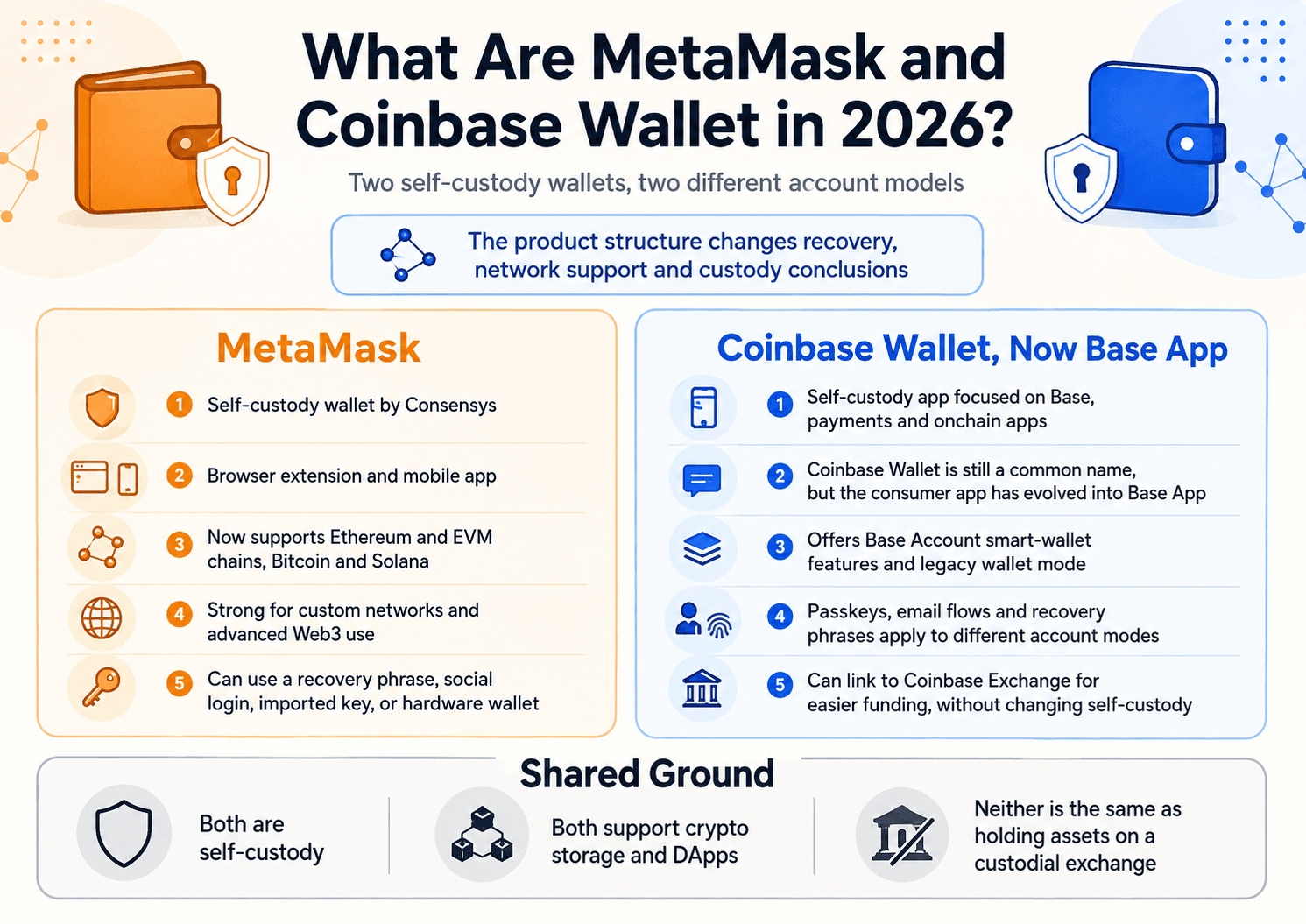
Sending USDC from MetaMask
MetaMask handles every EVM chain on the list above. The flow is the same on each network, but you must switch networks first or the wallet will sign on Ethereum mainnet by default.
- Open MetaMask and select the correct network from the dropdown at the top.
- Confirm you hold native USDC on that chain, not USDC.e.
- Tap Send and paste the recipient's wallet address.
- Enter the amount and review the estimated gas fee.
- Confirm the transaction and wait for the first confirmation.
Sending USDC from Coinbase Wallet
Coinbase Wallet, the self-custodial app rather than the exchange, supports USDC on Ethereum, Base, Polygon, Arbitrum, Optimism, Avalanche, and Solana. The send flow mirrors MetaMask on EVM chains. On Base, Coinbase Wallet may offer gasless USDC transfers through paymaster contracts, but this is not yet the default for every transaction.
Sending USDC from Phantom
Phantom started as a Solana wallet and has since added Ethereum, Base, Polygon, and Bitcoin. For USDC, it remains the cleanest Solana experience. Select the Solana network, choose USDC from your token list, paste the recipient address, and confirm. Fees are typically under a cent.
Sending USDC from Trust Wallet
Trust Wallet supports USDC on every major EVM chain plus Solana and Tron. Tron-native USDC exists but has limited exchange support outside Asia, so verify with the recipient before sending on Tron.
How Long Does a USDC Transfer Take?
On Solana, Base, Arbitrum, Optimism, Polygon, and Avalanche, USDC transfers feel instant from the sender's perspective, with first confirmations arriving in 1 to 5 seconds. Centralized exchanges, however, often wait for additional confirmations before crediting your account. Coinbase, Binance, and Kraken each publish their required confirmation counts per network on their support pages.
Ethereum mainnet reaches soft finality in about 13 minutes, making it the slowest of the major USDC rails. For layer-2 networks like Base, Arbitrum, and Optimism, there is a distinction between soft finality, when the sequencer confirms, and hard finality, when the layer-1 settlement window closes, typically after 7 days. For practical purposes such as wallet-to-wallet sends and exchange deposits, soft finality is what matters.
Do You Need the Native Gas Token to Send USDC?
Yes. USDC is an ERC-20 token on EVM chains and an SPL token on Solana, which means the transaction itself is paid in the chain's native asset. On Ethereum, Base, Arbitrum, and Optimism you need ETH. On Polygon you need MATIC. On Avalanche you need AVAX. On Solana you need SOL.
The amounts are small, often a few cents on layer-2 networks, but if you transfer USDC into a fresh wallet and try to send it back out, the transaction will fail until you fund some native gas. A handful of wallets, including Coinbase Wallet, now support gasless USDC transfers on Base via paymaster contracts, but it is not yet the default experience.
Cross-Chain USDC: When to Bridge vs When to Use CCTP
If you need to move USDC between chains, do not use a generic bridge that mints a wrapped version. Circle's Cross-Chain Transfer Protocol, or CCTP, burns native USDC on the source chain and mints native USDC on the destination. No wrapped tokens, no liquidity risk.
Most major wallets and aggregators, including Coinbase Wallet, MetaMask Bridge, and Eco Routes, route USDC cross-chain via CCTP by default. For step-by-step guidance, see Circle's official USDC send guide and the Circle Help Center transfer instructions.
The Most Common USDC Transfer Mistakes
Three errors account for the vast majority of lost or stuck USDC transfers, and all three are avoidable with a 30-second pre-send check.
1. Sending USDC.e When the Recipient Expects Native USDC
This is the most expensive mistake. Before sending, ask the recipient which token contract they accept. Check the contract address against Circle's official list or the chain's block explorer. If the destination is an exchange, use the deposit address and network shown on the exchange's deposit screen, not a generic wallet address.
2. Choosing the Wrong Network
Sending USDC on Ethereum when the recipient expects Base or Solana will not destroy the funds, but it can delay the transfer and force a manual recovery. Always match the network to the recipient's stated preference.
3. Forgetting the Native Gas Token
A wallet with USDC but no ETH, SOL, or MATIC cannot send anything. Fund a small amount of the native token before initiating the transfer, or use a wallet that supports gasless transfers on supported networks.
USDC Transfers for Business Spending
For businesses that hold USDC and need to spend it on subscriptions, advertising, or travel, the transfer step is only half the equation. Once USDC lands in a wallet, converting it into everyday business payments often means moving funds to an exchange, selling to fiat, and waiting for a bank settlement. That process adds time, fees, and manual reconciliation.
A growing alternative is to use a corporate crypto card platform that accepts stablecoin deposits directly. Cardfornia, for example, lets businesses fund a single account with USDC or USDT and issue multi-currency virtual cards to teams at scale. Instead of transferring USDC to an exchange and converting it for every payment, teams can spend against their stablecoin balance on AI tool subscriptions, digital advertising, SaaS services, and global travel. The platform keeps client funds in segregated accounts with third-party licensed custodians and settles card payments automatically in multiple currencies.
This does not replace the need to understand USDC transfers. Businesses still need to send USDC from a treasury wallet or exchange into the platform, and the same network checks apply. But it removes the repeated conversion and settlement steps that make stablecoin spending operationally heavy. For a deeper look at how stablecoin payments fit into business operations, see Pay with Stablecoins for Business: A Practical 2026 Guide.
Related reading
- RedotPay Review 2026: Fees, Features & Real Verdict - Evidence-based RedotPay review covering card fees, wallet features, transfers, real user complaints, regional limits, and who should actually use it in 2026.
- Cardfornia vs Request Finance vs BVNK: Which Fits? - Compare Cardfornia, Request Finance, and BVNK for stablecoin business spending, payouts, and corporate cards. See strengths, limits, and which fits your team.
Sources and further reading
- How to Send USDC: Networks, Fees, and Wallet Steps in 2026 - Pick the cheapest USDC rail, avoid USDC.e mix-ups, and send from MetaMask, Coinbase Wallet, Phantom, or Trust Wallet in under a minute.
Frequently Asked Questions
What is the cheapest network to transfer USDC?
Solana is typically the cheapest at under $0.01 per transfer. Base, Polygon, and Avalanche are also very low cost, usually between $0.01 and $0.20 depending on network conditions.
How long does a USDC transfer take?
On Solana, Base, Arbitrum, Optimism, Polygon, and Avalanche, transfers confirm in 1 to 5 seconds from the sender's perspective. Ethereum mainnet takes about 13 minutes for soft finality. Exchanges may require additional confirmations before crediting deposits.
Can I send USDC without ETH for gas?
On most EVM chains, no. You need a small amount of the native token, such as ETH on Ethereum or Base, MATIC on Polygon, or AVAX on Avalanche. Some wallets offer gasless USDC transfers on Base through paymaster contracts, but this is not universal.
What happens if I send USDC.e to an exchange that expects native USDC?
The funds may be lost or stuck in support for an extended period. Always confirm which version the recipient accepts and verify the token contract address before sending.
What is the safest way to move USDC between chains?
Use Circle's Cross-Chain Transfer Protocol, or CCTP, which burns native USDC on the source chain and mints native USDC on the destination. Most major wallets and bridges route USDC cross-chain via CCTP by default.
Can businesses use USDC for everyday spending?
Yes. Businesses can deposit USDC into a corporate crypto card platform like Cardfornia and issue virtual cards for subscriptions, advertising, SaaS, and travel. This avoids repeated conversion to fiat and manual settlement for every payment.
Conclusion
Transferring USDC is fast and inexpensive when you match the network to the recipient, confirm native versus bridged USDC, and keep a small native gas balance in the sending wallet. The most common losses come from avoidable mistakes: sending USDC.e to a native-only address, choosing the wrong chain, or forgetting gas. A 30-second pre-send check prevents nearly all of them.
For individuals, the process is now simple enough to complete in under a minute on most wallets. For businesses, the bigger opportunity is reducing the number of transfers and conversions required to spend stablecoins. Platforms that accept USDC directly for corporate card spending turn a multi-step transfer and settlement process into a single deposit, which is why more crypto-native teams are adopting stablecoin-backed corporate cards alongside their existing treasury workflows. To compare how stablecoin card platforms handle business spending, see Cardfornia vs Request Finance: Which Fits Your Business? and Corporate Travel Crypto Card: A 2026 Buyer's Guide.