
Top 10 Regulated Fiat-Backed Stablecoins in 2026
Top 10 Regulated Fiat-Backed Stablecoins in 2026
By 2026, the stablecoin market has matured beyond a niche crypto tool into a core component of the global payment infrastructure. Regulators across the US, EU, UK, and Asia have built clear frameworks, and enterprises are responding. The question is no longer "should we use stablecoins?" but "which one fits our compliance, treasury, and operational needs?"
This review ranks the top 10 regulated fiat-backed stablecoins that meet the highest standards for reserve transparency, regulatory standing, and real-world payment utility. We evaluate each product against five criteria: regulatory licensing, reserve attestation quality, blockchain availability, enterprise payment adoption, and ecosystem integration. Only stablecoins with a verifiable 1:1 fiat backing and active regulatory oversight are included. Algorithmic or crypto-collateralized tokens are excluded.
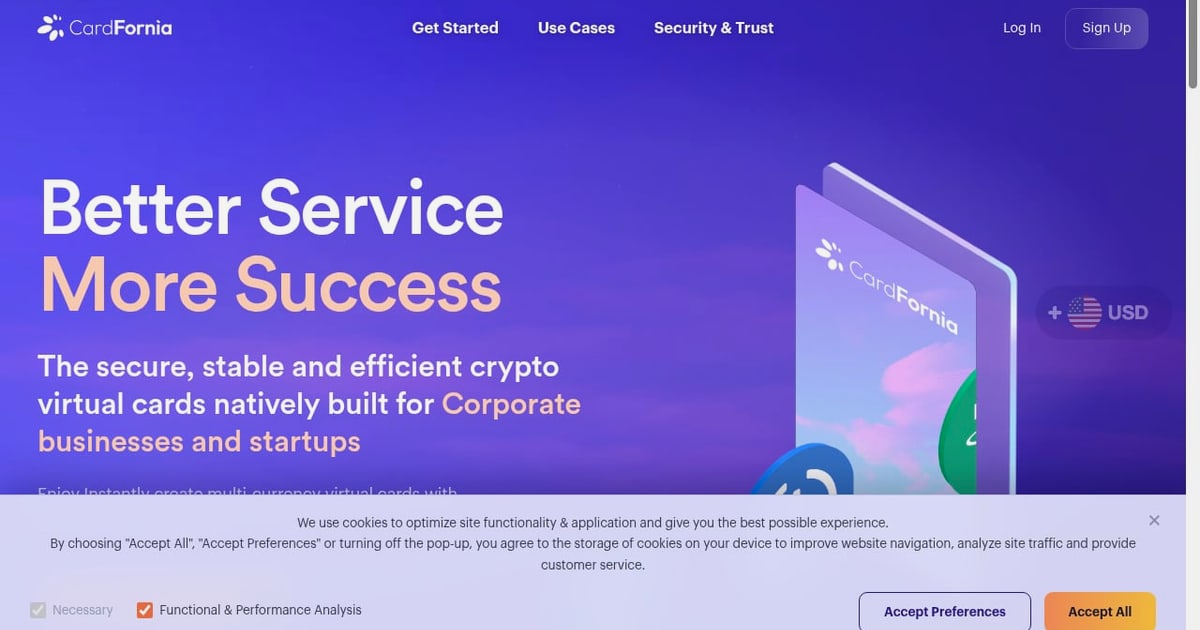
For businesses that need to spend these stablecoins efficiently, platforms like Cardfornia provide corporate virtual cards that let you fund cards directly with USDC or USDT, bridging compliant digital dollars with everyday business expenses like SaaS subscriptions and digital advertising.
Evaluation Criteria

First viewport screenshot of Cardfornia | Corporate Crypto Payment Cards.
To build this ranking, we applied a consistent framework:
- Regulatory Licensing: Does the issuer operate under a recognized framework such as the US GENIUS Act, EU MiCA, Singapore MAS, or equivalent?
- Reserve Transparency: Are reserves attested monthly by a top-tier audit firm? Are they held in cash, short-dated Treasuries, or equivalent high-quality liquid assets?
- Blockchain Availability: How many major blockchains support the stablecoin natively? Multi-chain support reduces vendor lock-in and settlement costs.
- Enterprise Payment Adoption: Is the stablecoin used for B2B settlement, payroll, or treasury operations—not just crypto trading?
- Ecosystem Integration: Is it embedded in banking, card networks, or fintech platforms that businesses already use?
Top 10 Regulated Fiat-Backed Stablecoins
USDC product interface.
1. USDC (USD Coin)
Issuer: Circle | Peg: USD | Market Cap: ~$77B | Chains: 30+
USDC is the benchmark for a regulated, transparent digital dollar. Circle holds a New York BitLicense and is fully compliant with the EU’s MiCA framework for Electronic Money Tokens. Its reserves—cash and short-duration US Treasuries—are attested monthly by Deloitte.
For enterprises, USDC’s multi-chain footprint (Ethereum, Solana, Base, Arbitrum, Avalanche, and more) and its Cross-Chain Transfer Protocol (CCTP V2) make it the most versatile option for moving value across networks. Visa and Mastercard both use USDC for settlement, and it is the default stablecoin for most regulated financial institutions. If your business needs a clean audit trail and broad interoperability, USDC is the first choice.
2. USDT (Tether)
Issuer: Tether Limited | Peg: USD | Market Cap: ~$185B | Chains: 15+
USDT remains the liquidity king. With roughly 60% of the total stablecoin market, it offers unmatched depth, especially in emerging-market corridors across Asia and Latin America. Tether now publishes daily reserve reports and quarterly attestations, and its reserves include a significant allocation to US Treasury bills.
While USDT’s regulatory standing is less uniform than USDC’s—it does not hold a MiCA license—its sheer network effect makes it indispensable for businesses that need to settle with counterparties who prefer USDT. Many enterprise treasuries hold both: USDC for regulated flows and USDT for liquidity-sensitive corridors.
3. PYUSD (PayPal USD)
Issuer: Paxos (for PayPal) | Peg: USD | Market Cap: ~$2.85B | Chains: Ethereum, Solana, Arbitrum, Stellar
PYUSD brings stablecoins to the PayPal ecosystem. Issued by Paxos under a NYDFS trust charter, it is backed 1:1 by USD deposits and Treasuries with monthly attestations. Its killer feature is direct integration with PayPal’s merchant network, which processed $1.79 trillion in payment volume in 2025.
For e-commerce businesses or platform-based disbursements already using PayPal, PYUSD is a natural on-ramp. It is also part of Mastercard’s stablecoin settlement network, alongside USDC. Liquidity outside the PayPal ecosystem is more limited, but within it, PYUSD is a powerful tool.
4. RLUSD (Ripple USD)
Issuer: Ripple | Peg: USD | Market Cap: ~$1.2B | Chains: XRP Ledger, Ethereum
Ripple launched RLUSD in late 2024 as a fully reserved, NYDFS-approved stablecoin. It is backed 1:1 by USD deposits, short-term Treasuries, and cash equivalents, with monthly attestations from a leading audit firm.
RLUSD is purpose-built for enterprise payments, leveraging Ripple’s existing network of financial institutions. It integrates natively with Ripple Payments for cross-border settlement, making it a strong candidate for banks and payment providers already using RippleNet. Its dual issuance on the XRP Ledger and Ethereum provides flexibility for both traditional and DeFi use cases.
5. EURC (Euro Coin)
Issuer: Circle | Peg: EUR | Market Cap: ~$1.5B | Chains: Ethereum, Solana, Avalanche, Stellar
EURC is the euro-denominated counterpart to USDC, issued under the same MiCA-compliant framework. It holds full Electronic Money Token status in the EU, with reserves held in euro-denominated bank accounts and government bonds.
For European businesses or any enterprise with significant euro-denominated payables, EURC eliminates FX friction. It is supported by major exchanges and is increasingly used for B2B settlement within the Single Euro Payments Area (SEPA) corridor.
6. USDG (Global Dollar)
Issuer: Paxos | Peg: USD | Market Cap: ~$800M | Chains: Ethereum, Solana
USDG is a newer entrant from Paxos, designed specifically for enterprise-grade payments. It operates under the same NYDFS trust charter as PYUSD and Paxos’s other stablecoins, with identical reserve and attestation standards.
What differentiates USDG is its focus on global treasury use cases. Paxos has partnered with several large fintech platforms to embed USDG as a settlement asset, and it is gaining traction among multinational corporations that want a single, regulated stablecoin for both internal treasury and external payments.
7. XSGD (StraitsX Singapore Dollar)
Issuer: StraitsX | Peg: SGD | Market Cap: ~$200M | Chains: Ethereum, Polygon
XSGD is the leading Singapore dollar stablecoin, issued by StraitsX under the MAS stablecoin framework. It is fully backed by Singapore dollar reserves held with licensed custodians and undergoes monthly attestations.
For businesses operating in Southeast Asia, XSGD provides a compliant way to hold and move Singapore dollars on-chain. It is widely used for cross-border payments, merchant settlement, and as an on-ramp to digital asset markets in the region.
8. EURCV (Societe Generale-FORGE EUR CoinVertible)
Issuer: Societe Generale-FORGE | Peg: EUR | Market Cap: ~$150M | Chains: Ethereum
EUR CoinVertible is a euro stablecoin issued by Societe Generale-FORGE, a fully regulated subsidiary of one of Europe’s largest banking groups. It is MiCA-compliant and backed by euro-denominated reserves held with Societe Generale.
This stablecoin stands out for its institutional pedigree. It is designed for interbank settlement, bond issuance, and other capital market use cases. While its market cap is modest, it represents the growing involvement of systemically important banks in the stablecoin space.
9. GYEN (GMO-Z.com Yen)
Issuer: GMO-Z.com Trust | Peg: JPY | Market Cap: ~$100M | Chains: Ethereum, Stellar
GYEN is the first regulated Japanese yen stablecoin, issued by a subsidiary of GMO Internet Group. It is approved by the New York Department of Financial Services and backed 1:1 by yen reserves.
For businesses with yen-denominated obligations, GYEN provides a rare compliant bridge between traditional Japanese banking and blockchain-based payment rails. It is particularly useful for trade settlement and payroll in Japan.
10. ZUSD (Z.com USD)
Issuer: GMO-Z.com Trust | Peg: USD | Market Cap: ~$80M | Chains: Ethereum, Stellar
ZUSD is the USD stablecoin from the same regulated trust that issues GYEN. It shares the same NYDFS charter and reserve standards, with monthly attestations and full 1:1 backing.
While ZUSD’s market cap is smaller than USDC or USDT, it offers a regulated alternative for businesses that value the GMO group’s track record in both traditional finance and digital assets. It is often used in tandem with GYEN for USD/JPY corporate treasury operations.
How to Choose a Regulated Stablecoin for Your Business

Image of a table place setting at a wedding.
Selecting the right stablecoin depends on your specific operational profile. Here is a practical decision framework:
- Regulatory priority: If you operate in the US or EU and need the highest compliance assurance, USDC or EURC are the safest defaults.
- Liquidity and reach: If you settle large volumes in emerging markets or need maximum counterparty acceptance, USDT is difficult to avoid.
- Ecosystem fit: If you already process payments through PayPal, PYUSD integrates seamlessly. If you use RippleNet for cross-border payments, RLUSD is a natural fit.
- Currency diversification: For non-USD needs, EURC, XSGD, and GYEN provide regulated options for euro, Singapore dollar, and yen exposures.
Many enterprises hold a basket of stablecoins to optimize for different corridors and use cases. A common pattern is USDC for core treasury and regulated flows, USDT for high-liquidity corridors, and a local-currency stablecoin for regional operations.
Once you have selected your stablecoins, you need efficient ways to spend them. Platforms like Cardfornia let you fund corporate virtual cards directly with USDC or USDT, enabling your team to pay for SaaS subscriptions, digital advertising, and procurement without converting back to fiat first.
The Role of Stablecoins in Corporate Spending

First viewport screenshot of Cardfornia | Corporate Crypto Payment Cards.
Holding regulated stablecoins is only half the equation. The other half is deploying them for real business expenses. This is where corporate virtual card platforms become essential.
Cardfornia, for example, enables businesses to issue multi-currency virtual cards funded by stablecoins like USDC and USDT. Use cases include:
- Digital advertising: High-limit cards for Meta Ads, Google Ads, and TikTok Ads reduce account ban risks.
- SaaS subscriptions: Pay for AWS, Azure, Figma, and other tools with automatic multi-currency settlement.
- Global procurement: Real-time currency exchange for cross-border purchases.
For a deeper comparison of how such platforms stack up, see our analysis of Cardfornia vs BVNK, where we examine why corporate virtual cards often beat pure infrastructure plays for team expense control.
Related reading
- Nuvei Review 2026: Global Payment Infrastructure Deep Dive - Evidence-based Nuvei review covering global pay-ins, payouts, local acquiring in 50+ markets, pricing signals, fraud tools, and ideal enterprise use cases.
- Developer Crypto Virtual Card: Build & Scale with APIs - Explore how developer crypto virtual cards and issuing APIs let fintechs, Web3 startups, and platforms embed branded cards, automate spending, and scale fast.
Sources and further reading
- Global stablecoin regulations 2026: What enterprises need to know - Industry insights
- Top Stablecoins for Business Payments in 2026 - Discover the top stablecoins for business payments in 2026, compare the leading options for different use cases, and learn how to choose the right ones for your business.
- Blog Post - Website operated by Fiat Republic Ltd, a company registered in England and Wales with company no. 13466461. Services provided in the United Kingdom by Fiat RepublicFinancial Services Ltd, with company no. 08649018 authorised and regulated by the Financial Conduct Authority (FRN 900524) as an electronic money institution.
FAQ
What is a regulated fiat-backed stablecoin?
A regulated fiat-backed stablecoin is a digital token pegged 1:1 to a national currency (like USD or EUR) and issued by an entity that operates under a recognized regulatory framework. Its reserves must be held in high-quality liquid assets and independently attested on a regular basis.
Which stablecoin is the most regulated in 2026?
USDC is widely considered the most comprehensively regulated stablecoin. It complies with the US GENIUS Act, the EU’s MiCA framework, and holds a New York BitLicense. Its reserves are attested monthly by Deloitte.
Can I use stablecoins for business payments?
Yes. In 2026, stablecoins are used for B2B settlement, cross-border payroll, supplier payments, and treasury management. Platforms like Visa and Mastercard now settle transactions in USDC, and corporate card solutions let you spend stablecoins directly.
What is the difference between USDC and USDT?
USDC prioritizes regulatory compliance and transparency, with monthly attestations and full MiCA authorization. USDT prioritizes liquidity and market reach, with deeper order books and broader acceptance in emerging markets. Many businesses hold both for different purposes.
Are euro or yen stablecoins regulated?
Yes. EURC and EURCV are MiCA-compliant euro stablecoins. GYEN is a regulated Japanese yen stablecoin issued under a NYDFS trust charter. XSGD is regulated under Singapore’s MAS framework.
Conclusion
The regulated fiat-backed stablecoin market in 2026 offers enterprises a range of compliant, transparent options for moving value on-chain. USDC leads on regulatory assurance and multi-chain infrastructure, while USDT dominates on liquidity. PYUSD, RLUSD, and regional stablecoins like EURC and XSGD provide targeted solutions for specific ecosystems and currencies.
Choosing the right stablecoin is a strategic decision that should align with your compliance requirements, geographic footprint, and payment workflows. And once you hold these digital dollars, pairing them with a corporate spending platform like Cardfornia can close the loop—turning stablecoin balances into actionable business payments without the friction of constant fiat conversion.