
Tokenbooks Review: Crypto Accounting Built for Web3 Finance Teams
Tokenbooks Review: Crypto Accounting Built for Web3 Finance Teams
Tokenbooks is a crypto accounting and treasury operations platform aimed at Web3 finance teams, DAOs, and fintech products that need to move beyond spreadsheets and manual exports. It syncs wallets, exchanges, and bank accounts into one auditable ledger, supports crypto and fiat payment workflows, and produces close-ready reports such as balance sheets, profit and loss statements, and trial balances.
This review examines what Tokenbooks actually does, who it fits best, where it shines, and where it may fall short. It is based on the product's published capabilities, integration surface, and the operational problems it targets rather than marketing claims alone.
What Tokenbooks Does
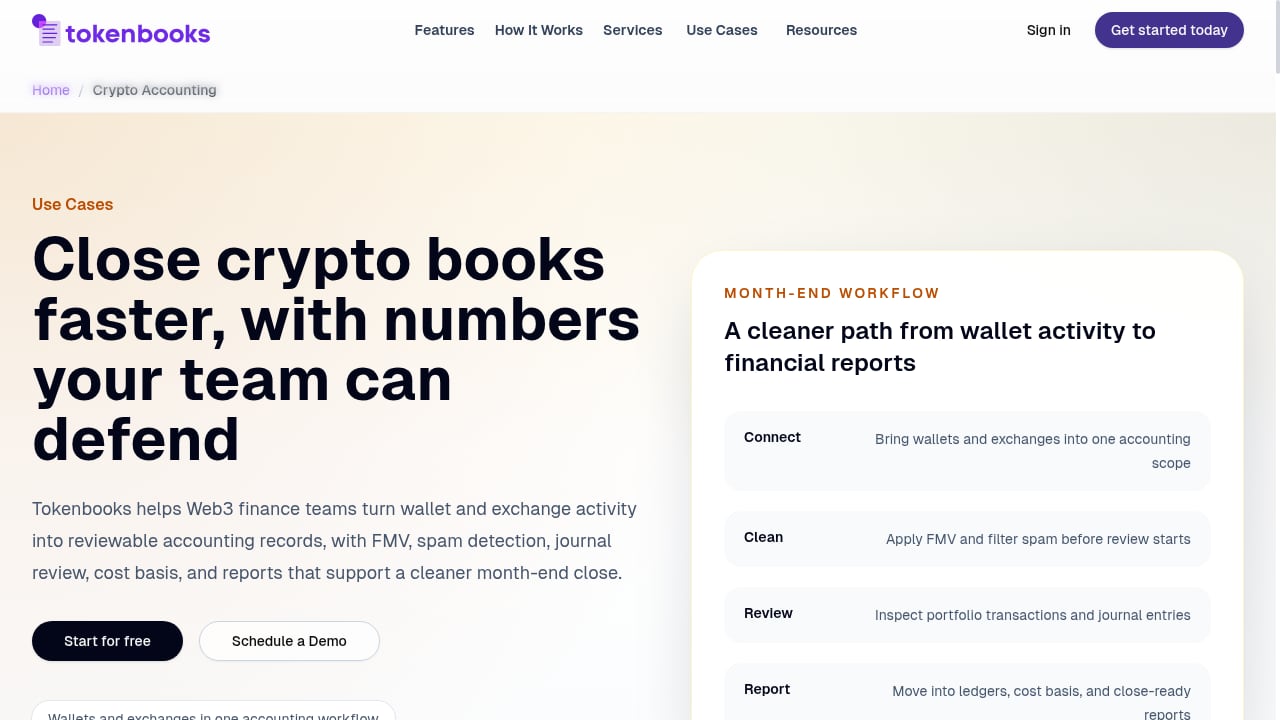
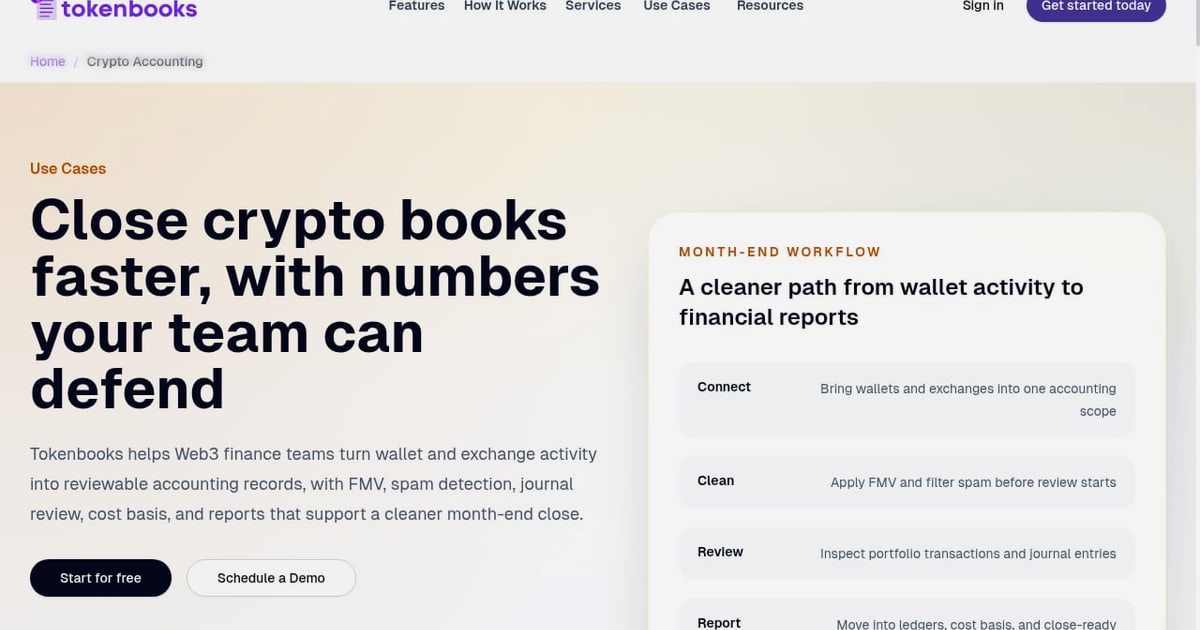
First viewport screenshot of Crypto Accounting For Web3 Finance Teams — Tokenbooks.
Tokenbooks positions itself as an enterprise-grade system for crypto-native organizations. The core promise is simple: bring fragmented wallet, exchange, and bank activity into a single accounting workflow that a controller or finance lead can actually review and sign off on.
The platform covers four connected areas:
- Crypto accounting: automated wallet synchronization, fair market value resolution, spam detection, journal entries, cost basis tracking, and close-ready reports.
- Payments and treasury: payment requests, approval routing, Safe-based execution, fiat payout workflows, and responsibility center budget tracking.
- Public API and embedded accounting: a REST API and first-party MCP server that let external products and AI agents interact with the accounting system while preserving an audit trail.
- AI-native workflows: driving Tokenbooks from Claude, ChatGPT, or a custom agent with sign-off gates intact.
The product is built for teams that need accounting controls, not just portfolio tracking. That distinction matters. Many crypto tools show balances and transaction history; Tokenbooks tries to turn that raw activity into reviewed, journaled, reportable financial data.
Ideal Users for Tokenbooks
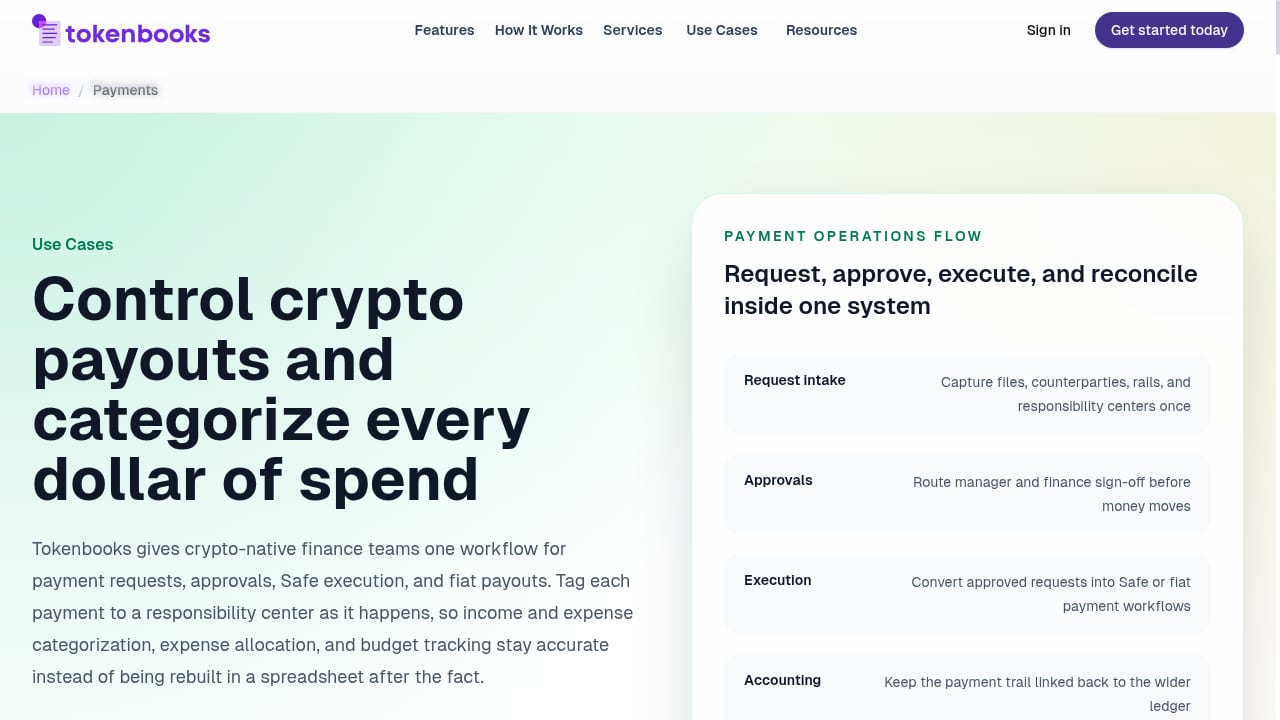
First viewport screenshot of Crypto Payments With Responsibility Center Budget Tracking — Tokenbooks.
Tokenbooks is not a general-purpose personal crypto tracker. The ideal buyer profile is narrow and specific.
Crypto-Native Companies and DAOs
Organizations that hold treasury in multiple tokens across EVM chains, Solana, NEAR, and exchanges like Kraken and Coinbase benefit most. These teams typically struggle with cost basis across hundreds of wallets, FMV at transaction time, and producing audit-ready records. Tokenbooks addresses that directly.
Web3 Finance Teams Replacing Spreadsheet Workflows
Finance leads who currently export CSV files from block explorers and exchanges, then rebuild activity in Excel, are the clearest fit. Tokenbooks replaces that manual reconciliation with synced activity, reviewable transactions, and journal entries that live in one place.
Fintech Products Embedding Accounting
Companies building portfolio apps, wallets, or trading platforms can use the public API to embed multi-chain accounting without building a ledger from scratch. The MCP server extends this to AI agents that need to query or update accounting data under controlled permissions.
Teams Running Crypto and Fiat Payments Together
If your organization pays contributors, vendors, or grantees in both stablecoins and fiat, the payment request and approval workflow tied back to the same ledger is a meaningful advantage. Safe-based execution also appeals to DAOs that require multisig controls.
Key Strengths
Tokenbooks Review: Crypto Accounting Built for Web3 Finance Teams - Key Strengths.
One Auditable Ledger Across Sources
The most valuable design choice is that wallets, exchanges, and bank accounts live in the same accounting scope. This removes the common problem of reconciling a crypto subledger against a fiat general ledger at month-end.
Reviewable Transactions and Journals
Tokenbooks emphasizes review over automation. Finance teams can inspect portfolio transactions, open the underlying journal entries, and add comments without leaving the system. This keeps audit context attached to the numbers rather than scattered across Slack, email, and spreadsheets.
Close-Ready Reporting
The platform generates balance sheets, profit and loss statements, and trial balances from synced activity. For teams that currently close books manually, this is a significant time reduction. The permissioned period close also supports controller-style controls.
Payment Workflows Tied to Accounting
Payment requests, approval routing, Safe execution, and fiat payouts all flow back into the same ledger. This closes the loop between operations and accounting that most crypto payment tools leave open.
AI-Native Access with Audit Trail
The MCP server and REST API allow AI agents to interact with the accounting system. The key differentiator is that these interactions remain within the audit trail and sign-off gates. That is a more controlled approach than letting an AI agent write directly to a spreadsheet or database.
No Private Key Storage
Tokenbooks states that it never stores private keys. For treasury teams evaluating any crypto platform, this is a non-negotiable security requirement and a meaningful trust signal.
Limitations and Considerations
Young Product with Limited Public Review History
Tokenbooks does not yet have a large volume of independent customer reviews on major software marketplaces. Buyers who rely heavily on third-party validation may find the evidence base thin. Due diligence should include a direct demo and reference calls.
Narrow Focus on Web3 Finance Teams
The product is not designed for individual investors, small hobbyist portfolios, or traditional businesses with incidental crypto holdings. If your needs are simple portfolio tracking, lighter tools will be more appropriate and less expensive.
Pricing Transparency
Tokenbooks does not publish pricing on its website. This is common for enterprise software, but it means evaluation requires a sales conversation. Teams with tight budgets should clarify pricing early in the process.
Learning Curve for Non-Accounting Users
Because the product emphasizes journal entries, cost basis, and close workflows, it assumes a baseline understanding of accounting concepts. Founders or operators without finance training may need support from a bookkeeper or accountant during setup.
Integration Depth Varies
The platform highlights integrations with EVM chains, Kraken, Coinbase, Ledger, Solana, and NEAR. Teams using less common chains or niche exchanges should confirm coverage before committing.
Pricing Signals
Tokenbooks uses an enterprise sales model with no public pricing page. This signals that pricing is likely customized based on transaction volume, number of wallets and exchanges synced, payment workflow usage, and API access needs.
For evaluation purposes, expect pricing to scale with operational complexity rather than a flat per-seat fee. Ask specifically about:
- Monthly sync limits and overage costs
- Whether payment workflows and Safe execution are included or add-ons
- API and MCP server access tiers
- Setup and onboarding fees
- Contract length and early termination terms
Setup and Onboarding
Based on the published workflow, setup follows three stages:
- Connect sources: add the wallets, exchanges, and bank accounts your team uses. Tokenbooks supports 100+ blockchains and exchanges, including EVM chains, Solana, NEAR, Kraken, Coinbase, and Ledger hardware wallets.
- Review activity: move from raw synced data into reviewed transactions, journal entries, and comments. This is where finance context gets attached.
- Run workflows: generate ledgers and reports, execute payment requests, and use the API or MCP server for embedded or AI-driven workflows.
Teams that need hands-on help can also use Tokenbooks' bookkeeping service, where the company keeps the books for you. This is a useful option for organizations without in-house crypto accounting expertise.
How Tokenbooks Compares to Alternatives
Tokenbooks vs. General Crypto Portfolio Trackers
Portfolio trackers show balances and transaction history. Tokenbooks adds journal entries, cost basis, FMV resolution, and close-ready financial statements. If you need auditable books, a tracker is insufficient. If you only need to monitor holdings, Tokenbooks is overkill.
Tokenbooks vs. Traditional Accounting Software with Crypto Add-Ons
Traditional platforms often treat crypto as a side module with limited chain coverage and weak on-chain reconciliation. Tokenbooks is crypto-first, with fiat bank accounts reconciled in the same ledger. The trade-off is that Tokenbooks is not a full ERP replacement for payroll, invoicing, or tax filing beyond accounting workflows.
Tokenbooks vs. Crypto Payment Processors
Payment processors focus on moving funds. Tokenbooks focuses on the accounting consequences of those movements. Teams that already use a crypto spending or payment tool may still need Tokenbooks to keep the books clean. For example, if your team manages corporate crypto cards or stablecoin spending, you may want to review team crypto card management practices alongside your accounting stack.
Tokenbooks vs. Manual Spreadsheets
The comparison is stark. Spreadsheets require manual exports, fragile formulas, and no native audit trail. Tokenbooks automates sync and keeps review context inside the system. The cost is a subscription and a learning curve.
Decision Criteria: Is Tokenbooks Right for You?
Choose Tokenbooks if:
- You operate a DAO, crypto-native company, or fintech product with meaningful on-chain activity.
- Your finance team spends days each month reconciling wallets and exchanges in spreadsheets.
- You need journal entries, cost basis, and close-ready reports that can survive an audit.
- You want payment workflows tied back to the same accounting ledger.
- You plan to let AI agents interact with accounting data under controlled permissions.
Look elsewhere if:
- You are an individual investor or small project with simple tracking needs.
- You need a full ERP with payroll, invoicing, and tax modules.
- You require transparent public pricing before engaging with sales.
- Your chain and exchange coverage is outside Tokenbooks' supported integrations.
Related reading
- What Is a Digital Dollar? CBDCs, Stablecoins, and the 2026 Policy Shift - Learn what a digital dollar really means in 2026: CBDC proposals, the GENIUS Act, regulated stablecoins, and how businesses can spend digital dollars today.
- Kripicard Review: Crypto Virtual Cards for Business Spending - Evidence-based Kripicard review covering USDT virtual cards, ideal users, setup, fees, security, and how it compares for ad spend and team payments.
- Segregated Payment Cards: What They Are and How They Work - Learn what segregated payment cards are, how segregated accounts protect funds, and when segregated card processing makes sense for your business.
Sources and further reading
- Best Crypto Accounting Software: User Reviews from August 2026 - Customer Review. Pricing. Pricing Available. Language. English. Solution Type. All-in-One. Best-of-Breed. Sort by ... Read Tokenbooks Reviews. Product Description.
- Crypto Accounting & Treasury Software for Web3 Teams | Tokenbooks - Crypto accounting, treasury, and payments on one auditable ledger. Sync wallets, exchanges, and bank accounts, pay in crypto or fiat, and close books faster.
- Thomas Fordham - Chief Crypto Accounting Engineer @ Tokenbooks - ... review and profitability. Former IT Professional, start-up survivor, life-long programmer, and Excel maven with expertise in multiple disciplines including ...
FAQ
What is Tokenbooks used for?
Tokenbooks is used for crypto accounting, treasury operations, and payment workflows. It syncs wallets, exchanges, and bank accounts into one auditable ledger, supports crypto and fiat payments, and produces close-ready financial reports.
Does Tokenbooks support DAOs?
Yes. Tokenbooks targets DAOs and crypto-native organizations. Safe-based payment execution, approval routing, and responsibility center budget tracking are designed for multisig-controlled treasuries and decentralized teams.
Does Tokenbooks store private keys?
No. Tokenbooks states that it never stores private keys. Wallet connections are used for read-only synchronization and transaction visibility, not custody.
What reports does Tokenbooks generate?
Tokenbooks generates balance sheets, profit and loss statements, trial balances, cost basis reports, and ledger exports that support the financial close process.
Does Tokenbooks have a public API?
Yes. Tokenbooks offers a public REST API and a first-party MCP server. These allow external products and AI agents to interact with the accounting system while maintaining a full audit trail.
Is Tokenbooks free?
Tokenbooks does not publish pricing and operates on an enterprise sales model. Pricing is likely customized based on usage, integrations, and feature needs. Contact the company for a quote.
Can Tokenbooks handle fiat payments?
Yes. Tokenbooks supports fiat payout workflows alongside crypto payments. Both payment types tie back to the same accounting ledger.
Conclusion
Tokenbooks is a focused, serious tool for a specific problem: Web3 finance teams drowning in manual reconciliation and unable to produce audit-ready books. Its strengths are the unified ledger, reviewable journal entries, close-ready reporting, and payment workflows that connect operations to accounting.
The main trade-offs are a young product with limited independent review history, opaque enterprise pricing, and a scope that deliberately excludes casual users. For DAOs, crypto-native companies, and fintech products that need embedded accounting, Tokenbooks deserves a place on the shortlist. For everyone else, lighter tools will likely suffice.
If your organization also manages corporate crypto spending, consider reviewing crypto corporate virtual card platforms to understand how spending tools fit alongside an accounting system like Tokenbooks. For teams evaluating stablecoin treasury strategy, the USDC vs USDT comparison provides useful context on which assets to hold and spend.