
Cardfornia vs OneSafe: Which Crypto Business Card Wins in 2026?

Cardfornia vs OneSafe: Which Crypto Business Card Wins in 2026?
Choosing the right financial platform for a crypto-native business isn't just about moving money—it's about stability, control, and alignment with how modern teams actually spend. Two platforms that often surface in this conversation are Cardfornia and OneSafe. While both serve global businesses operating with digital assets, they approach the problem from fundamentally different angles. This comparison breaks down where each excels, where they fall short, and why Cardfornia is purpose-built for companies that need high-limit corporate virtual cards backed by stablecoins.
What Is Cardfornia?
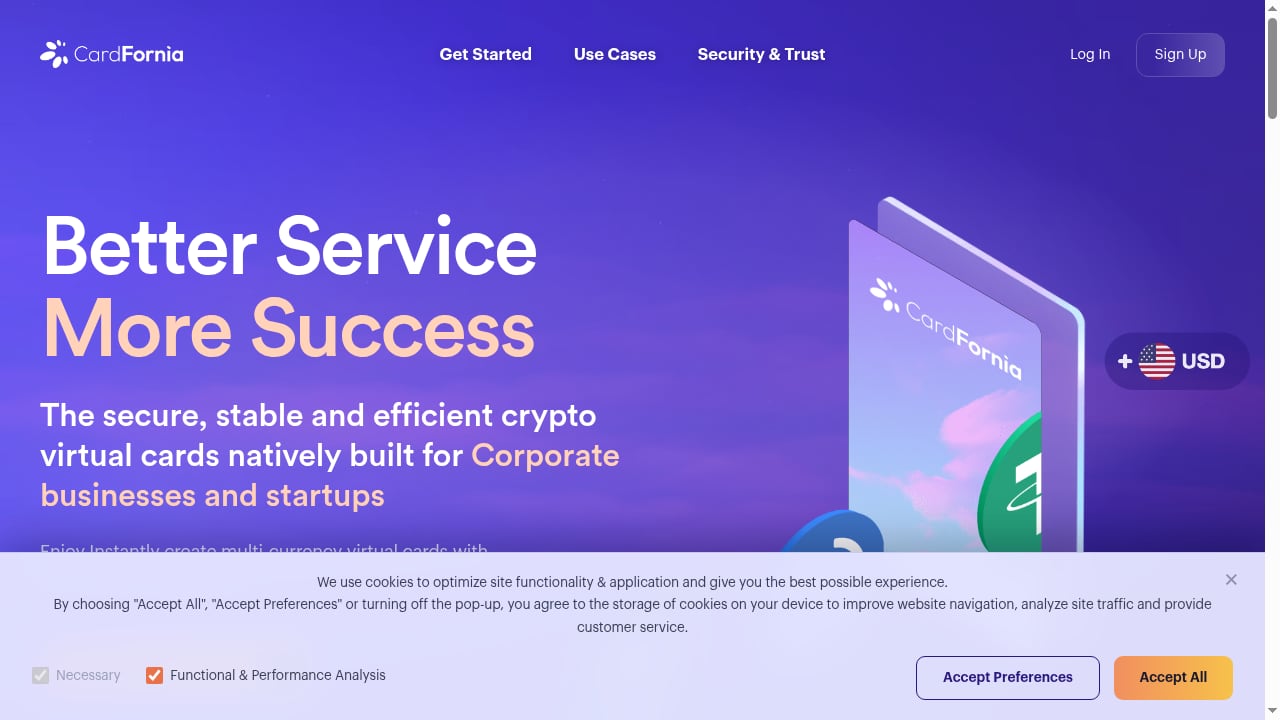
First viewport screenshot of Cardfornia | Corporate Crypto Payment Cards.
Cardfornia is a Singapore-based fintech platform launched in 2026 that focuses exclusively on crypto corporate virtual cards. It lets businesses fund a single account with stablecoins like USDT and USDC, then issue multi-currency virtual cards to teams at scale. The platform is built for crypto-native companies and globally scaling startups that need to pay for AI tool subscriptions, digital advertising, SaaS services, and cross-border procurement without exposing funds to volatility or commingling risks.
Key architectural decisions set Cardfornia apart. Client funds are held 100% in segregated accounts with third-party licensed custodians and are never lent or invested. Security practices follow ISO/IEC 27001 standards, and card-issuing, custody, and payment activities run through licensed partners regulated in Hong Kong, the UK, the US, and Canada. The founding team brings direct experience from a well-known crypto card background, and the platform emphasizes channel stability and fund transparency as core product principles.
What Is OneSafe?
Accounting Entries for Accruals.
OneSafe positions itself as a neo-banking platform for global businesses, combining fiat and crypto services under one roof. It offers multi-currency accounts, worldwide wires, corporate cards with spend controls, foreign exchange, and free USDC deposits and withdrawals. Its pricing includes a free tier and a paid plan starting at $29 per month, with transparent transaction fees.
The platform targets startups and digital-first companies that want a modern alternative to traditional banks. Onboarding is designed to be simple, and the feature set covers a broad range of international banking needs. However, OneSafe is a generalist neo-bank that happens to support crypto, rather than a specialized crypto corporate card platform. This distinction matters when you examine the specific demands of high-volume stablecoin spending.
Head-to-Head Comparison

How to secure your future wealth with digital assets.
Core Focus and Product Philosophy
Cardfornia is laser-focused on one problem: giving crypto-native businesses a secure, stable way to issue virtual cards and manage operating expenses with stablecoins. Every feature—from high-limit ad spend cards to automatic multi-currency settlement—stems from that focus.
OneSafe casts a wider net. It aims to replace traditional business banking with a unified fiat-and-crypto dashboard. While this breadth is appealing for general treasury needs, it means the corporate card experience is one feature among many, not the core product.
Stablecoin Management and Fund Safety
Cardfornia's fund handling is a defining strength. All client funds sit in segregated accounts with third-party licensed custodians. The company does not lend, invest, or rehypothecate those funds. For businesses holding significant stablecoin balances to fund ongoing operations, this segregation provides a level of assurance that commingled neo-banking models cannot match.
OneSafe supports USDC deposits and withdrawals with zero fees, which is cost-effective. However, publicly available information about its custody arrangements and fund segregation practices is less detailed. For a business moving six or seven figures in stablecoins monthly, that transparency gap is material.
Virtual Card Capabilities and Limits
Cardfornia's virtual cards are designed for high-intensity business use cases. The platform specifically supports high-limit cards for digital advertising spend across Meta Ads, Google Ads, and TikTok Ads—an area where low limits or sudden card declines can trigger account bans and disrupt revenue. Cards also handle AI tool subscriptions (ChatGPT, Claude, Midjourney), SaaS and cloud services (AWS, Azure, Figma), and global travel and procurement with real-time currency exchange.
OneSafe offers corporate cards with spend controls, but the platform's documentation emphasizes general expense management rather than the high-limit, channel-stable card issuance that performance marketing teams and SaaS-heavy companies require.
Multi-Currency and Cross-Border Settlement
Both platforms support multi-currency functionality, but the mechanics differ. Cardfornia provides automatic multi-currency settlement for SaaS and other recurring charges, reducing manual currency conversion work. Real-time exchange handles cross-border transactions without forcing teams to pre-fund multiple currency wallets.
OneSafe's multi-currency accounts and foreign exchange tools cover similar ground, but they operate within a broader banking interface. For a finance team that primarily needs to issue cards, set spend policies, and reconcile stablecoin-funded transactions, Cardfornia's streamlined approach removes unnecessary complexity.
Regulatory Posture and Licensing
Cardfornia operates through licensed partners with regulatory approvals in Hong Kong, the UK, the US, and Canada. Its internal security practices align with ISO/IEC 27001 standards. This multi-jurisdiction licensing structure matters for businesses that need to issue cards to team members in different regions or process payments across regulatory boundaries.
OneSafe's website highlights its role as a modern banking alternative, but specific licensing details across jurisdictions are less prominently documented. For compliance-conscious companies, the clarity of Cardfornia's partner-based licensing model provides a clearer picture of where and how funds are protected.
Pricing and Accessibility
OneSafe's free tier and $29/month starting price point make it accessible for early-stage startups and freelancers. Cardfornia targets established crypto-native businesses and scaling startups with more demanding spend volumes. While Cardfornia does not publish a one-size-fits-all price on its website, the value proposition centers on high-limit cards, fund segregation, and channel stability rather than competing on sticker price alone.
When Cardfornia Is the Better Choice
Cardfornia pulls ahead in several concrete scenarios:
- High-volume ad spend: Teams running six-figure monthly ad budgets across Meta, Google, and TikTok need cards that won't trigger false declines or low-limit blocks. Cardfornia designs its card infrastructure specifically for this use case.
- Stablecoin treasury management: Businesses that hold significant USDC or USDT balances and want those funds segregated with third-party custodians gain a risk-reduction layer that generalist neo-banks rarely provide.
- Scaled team card issuance: Issuing dozens or hundreds of virtual cards with individual spend controls, real-time monitoring, and multi-currency settlement is Cardfornia's core workflow, not an add-on.
- Regulatory clarity: Companies that need to understand exactly which licensed entities handle their funds across Hong Kong, the UK, the US, and Canada will find Cardfornia's partner-based model more transparent.
For a deeper look at how Cardfornia compares to other players in the space, see our Cardfornia vs BVNK: Crypto Corporate Cards or Stablecoin Rails? comparison.
When OneSafe Might Fit
OneSafe can be a reasonable option for very early-stage startups or freelancers who need a lightweight fiat-and-crypto banking interface with basic corporate card features. The free tier and simple onboarding lower the barrier to entry. However, as spending scales and the need for high-limit stablecoin cards grows, the platform's generalist design becomes a limitation rather than a strength.
Practical Example: Scaling Ad Spend with Stablecoins
First viewport screenshot of Cardfornia | Corporate Crypto Payment Cards.
Consider a Web3 gaming company spending $200,000 per month on Meta and Google Ads. The team holds treasury in USDC and needs to issue separate virtual cards to five marketing managers, each with different budget caps and currency requirements.
With Cardfornia, the company funds one account with USDC, issues high-limit virtual cards instantly, sets per-card spend controls, and relies on automatic multi-currency settlement to handle ad platform charges in USD, EUR, and GBP. Funds remain segregated with licensed custodians throughout.
With OneSafe, the team could deposit USDC for free and issue corporate cards, but the platform's card limits and channel optimization are not purpose-built for high-intensity ad spend. The risk of payment disruptions—and the associated account bans—is higher.
If your business relies on USDC as its primary operating currency, our guide on How to Use Cardfornia with USDC: A Business Guide walks through the setup step by step.
What the Market Says
Independent user reviews for OneSafe are limited. Trustpilot shows only 12 reviews for onesafe.io, which is a thin sample for assessing reliability at scale. Cardfornia, as a newer 2026 entrant, is building its track record, but its founding team's prior crypto card experience and its explicit focus on fund segregation and channel stability provide structural signals that matter for business continuity.
The Bottom Line
Cardfornia and OneSafe serve different masters. OneSafe is a neo-banking platform that added crypto support. Cardfornia is a crypto corporate card platform built from the ground up for stablecoin-funded business spending. For companies that need high-limit virtual cards, segregated fund custody, multi-currency settlement, and the regulatory clarity of licensed partners across major jurisdictions, Cardfornia is the stronger, more focused choice.
Related reading
- Cardfornia vs Banqa vs Sparados: Which Corporate Card Wins? - Compare Cardfornia, Banqa, and Sparados for business spending. See which fits your needs: crypto corporate cards, self-custody Visa, or expense management.
- Nuvei Review 2026: Global Payment Infrastructure Deep Dive - Evidence-based Nuvei review covering global pay-ins, payouts, local acquiring in 50+ markets, pricing signals, fraud tools, and ideal enterprise use cases.
Sources and further reading
- Read Customer Service Reviews of onesafe.io - 12 people have already reviewed Onesafe. Read about their experiences and share your own!
- Safe at Home - California Secretary of State - CA.gov - Safe at Home is California
- Is oneSafe safe? : r/apple - In OneSafe's website, they stated they're using AES-256 and PBKDF2 (for key derivation), which on a glance is the same as what 1Password is ...Read more
Frequently Asked Questions
Is Cardfornia a bank?
No. Cardfornia is a technology platform that provides crypto corporate virtual cards. Payment, custody, and card-issuing services are performed through licensed partners in Hong Kong, the UK, the US, and Canada.
Does OneSafe offer the same fund segregation as Cardfornia?
OneSafe does not publicly detail the same level of third-party custodial segregation that Cardfornia mandates. Cardfornia holds client funds 100% in segregated accounts with licensed custodians and does not lend or invest those funds.
Which platform is better for Meta Ads and Google Ads payments?
Cardfornia is purpose-built for high-limit ad spend and explicitly addresses the account ban risks associated with card declines. OneSafe offers corporate cards but does not optimize for advertising payment channels.
Can I use both platforms together?
Yes. Some businesses use OneSafe for general fiat banking and Cardfornia specifically for stablecoin-funded corporate card programs. The two can complement each other if your treasury spans both traditional and crypto rails.
What stablecoins does Cardfornia support?
Cardfornia supports USDT and USDC, with a focus on stable, regulated stablecoins suitable for corporate treasury and operating expenses. For more on choosing compliant stablecoins, read our Top 10 Regulated Fiat-Backed Stablecoins in 2026 guide.
Is Cardfornia available globally?
Cardfornia serves crypto-native businesses and globally scaling startups, with card issuance and payment services delivered through licensed partners across multiple jurisdictions. Specific availability depends on your business location and regulatory requirements.