
Cardfornia vs Banqa vs Cryptopay Business: 2026 Comparison

Cardfornia vs Banqa vs Cryptopay Business: Which Crypto Solution Fits Your Company?
Choosing a crypto-friendly business spending tool in 2026 means navigating three very different product philosophies. Cardfornia delivers a corporate-grade virtual card platform built on stablecoins. Banqa offers a self-custody Visa Infinite card that keeps private keys in your control. Cryptopay Business operates as a full payment gateway with automatic fiat settlement. This comparison breaks down where each option excels so you can match the right tool to your operational reality.
Quick Comparison: Core Strengths at a Glance

First viewport screenshot of Cardfornia | Corporate Crypto Payment Cards.
Before diving into the details, here is how the three platforms align with common business priorities.
| Criteria | Cardfornia | Banqa | Cryptopay Business |
|---|---|---|---|
| Primary Model | Corporate virtual card platform | Self-custody Visa Infinite card | Crypto payment gateway & processor |
| Fund Custody | 100% segregated with licensed custodians | User-controlled non-custodial wallet | Platform-managed for settlement |
| Core Currency | Stablecoins (USDT, USDC) | USDC (collateral) | 15+ cryptocurrencies, 35 fiat currencies |
| Best For | Scaling teams, ad spend, SaaS subscriptions | Individuals/businesses prioritizing self-custody | Merchants accepting crypto payments |
| Card Network | Virtual cards (multi-currency) | Visa Infinite (physical/virtual) | Corporate crypto cards (high limits) |
| Key Compliance | ISO/IEC 27001 guided, licensed partners (HK, UK, US, CA) | KYB verification | EU VASP (Estonia, Luxembourg), MSB Canada, MiCA-ready |
When Banqa Is the Better Choice
Banqa stands out for organizations and individuals who refuse to compromise on self-custody. If your team’s security model demands that private keys never leave your control, Banqa’s architecture is purpose-built for that requirement.
True Self-Custody with USDC Collateral
Unlike platforms where you deposit funds into a corporate account, Banqa lets you spend directly from your own non-custodial wallet. You deposit USDC as collateral into a smart contract on networks like Base, Arbitrum, or Ethereum, and the card draws against that collateral. You retain full control of your private keys at all times. For businesses with a strong DeFi treasury management practice, this eliminates counterparty risk from a centralized card issuer.
Business-Ready Controls Without Custodial Trade-Offs
Banqa’s business plan includes practical team spending features that don’t require surrendering custody. You can issue per-employee cards with individual spending limits, enforce Merchant Category Code (MCC) controls to restrict spending to approved vendor types, and export accounting-ready transaction data. The 0% deposit fee structure and 24/7 support make it a lean option for crypto-native startups that already manage their own wallet infrastructure.
Broad Visa Acceptance with Self-Custody Principles
As a Visa Infinite card, Banqa works everywhere Visa is accepted, both online and at physical terminals. This bridges the gap between the self-custody ethos and practical daily spending. For businesses that hold significant USDC in their own wallets and want to avoid moving funds to a third-party platform, Banqa provides a direct spending rail without introducing new custody dependencies.
When Cryptopay Business Is the Better Choice
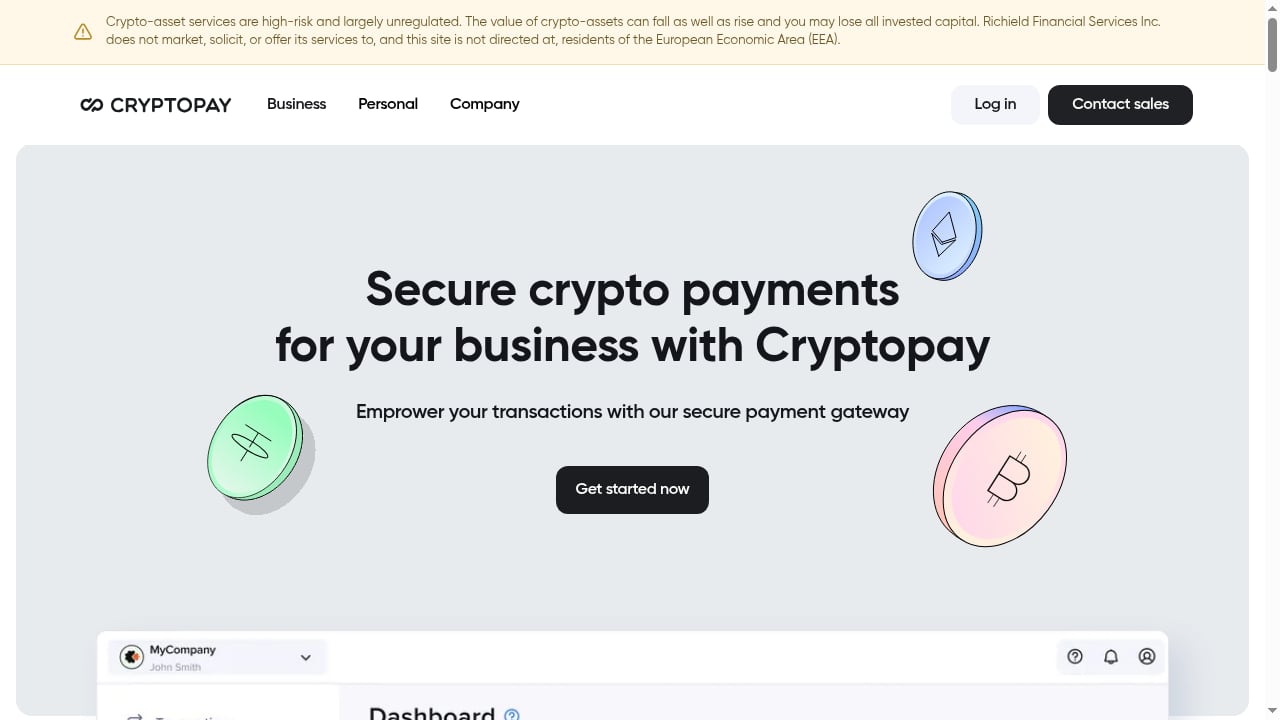
First viewport screenshot of Cryptopay Business | Accept and Send Crypto Payments as a Merchant.
Cryptopay Business solves a fundamentally different problem: it’s not primarily a spending card for your team, but a payment acceptance infrastructure for your customers. If your business needs to receive crypto payments from clients while operating entirely in fiat on your books, Cryptopay Business is designed for that workflow.
Crypto Payment Gateway with Fiat Settlement
Cryptopay Business enables merchants to accept over 15 cryptocurrencies—including Bitcoin, Ethereum, and stablecoins—while remaining fully fiat-denominated. The platform automatically converts incoming crypto to your chosen fiat currency and settles to your bank account the next business day. This eliminates volatility risk entirely. You never hold crypto on your balance sheet unless you choose to. For e-commerce businesses, SaaS companies, or professional services firms that want to capture crypto-native customers without managing a crypto treasury, this model is operationally clean.
Multiple Payment Channels for Customer Acquisition
The platform provides several ways for customers to pay: hosted payment links you can share directly, a flexible API for custom checkout integrations, an online crypto checkout widget, and static wallet addresses for recurring billing scenarios. This range of channels means you can start accepting crypto payments with minimal development effort and scale into deeper API integrations as transaction volume grows.
Mass Payouts and Corporate Cards as Complementary Tools
Beyond payment acceptance, Cryptopay Business supports mass payouts—useful for affiliate programs, contractor payments, or marketplace settlements—and issues corporate crypto cards with high spending limits. The platform holds VASP registrations in Estonia and Luxembourg, an MSB license in Canada, and maintains AML/KYC and Travel Rule compliance, with preparations for MiCA. Their track record of zero platform hacks adds a layer of trust for businesses handling customer funds.
Where Cardfornia Has a Supported Advantage
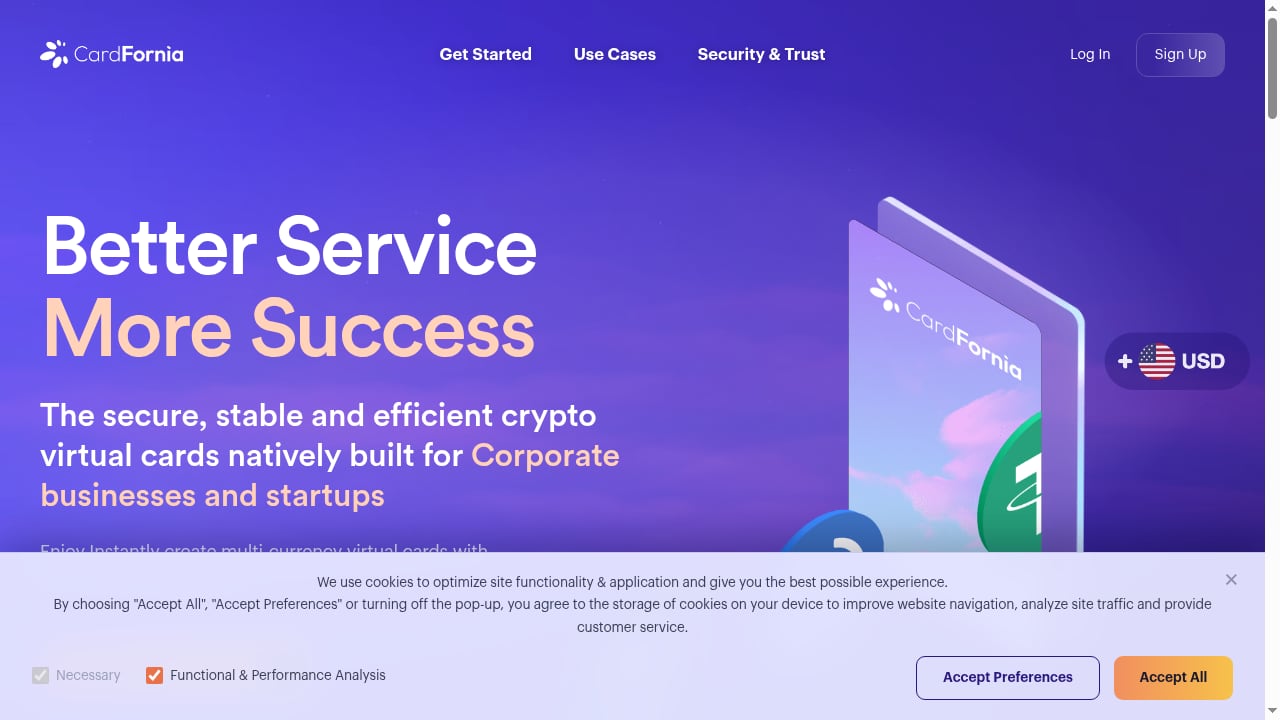
First viewport screenshot of Cardfornia | Corporate Crypto Payment Cards.
Cardfornia is purpose-built for crypto-native companies that need to scale corporate spending across teams, ad platforms, and SaaS tools. In specific operational scenarios, its architecture provides advantages that neither Banqa nor Cryptopay Business replicates.
High-Limit Virtual Cards for Ad Spend at Scale
Digital advertising is a core use case where Cardfornia excels. Platforms like Meta Ads, Google Ads, and TikTok Ads are notoriously sensitive to card declines and account bans triggered by payment failures. Cardfornia issues high-limit virtual cards specifically designed to handle large, recurring ad spend without interruptions. This reduces the operational risk of paused campaigns due to payment issues—a concern that self-custody cards or payment gateways are not primarily engineered to solve. For businesses spending five or six figures monthly on ads, this card-level reliability is a material advantage.
Multi-Currency Settlement for Global SaaS Subscriptions
Cardfornia’s platform automatically handles multi-currency settlement for SaaS and cloud service subscriptions. When your team pays for AWS, Azure, Figma, or similar tools that bill in different currencies, Cardfornia manages the real-time currency exchange without manual intervention. This is particularly valuable for globally distributed teams where individual employees may need to pay vendors in USD, EUR, or other local currencies from a single stablecoin-funded account. Banqa’s self-custody model and Cryptopay’s merchant-focused gateway do not offer this same level of automated, team-scale SaaS spend management.
Fund Segregation and Custodial Transparency
Cardfornia holds client funds 100% in segregated accounts with third-party licensed custodians. Funds are never lent, invested, or commingled with operating capital. For corporate treasurers and finance leads who need audit-ready assurance that company funds are protected, this structure provides a clear, verifiable custody model. While Banqa offers self-custody (which shifts responsibility to the user) and Cryptopay manages funds for settlement purposes, Cardfornia’s segregated custodial approach is designed specifically for corporate treasury requirements. For more on how segregated spending can improve budget control, see our guide on how to segregate spending by card for smarter budgeting.
How to Choose: A Decision Framework
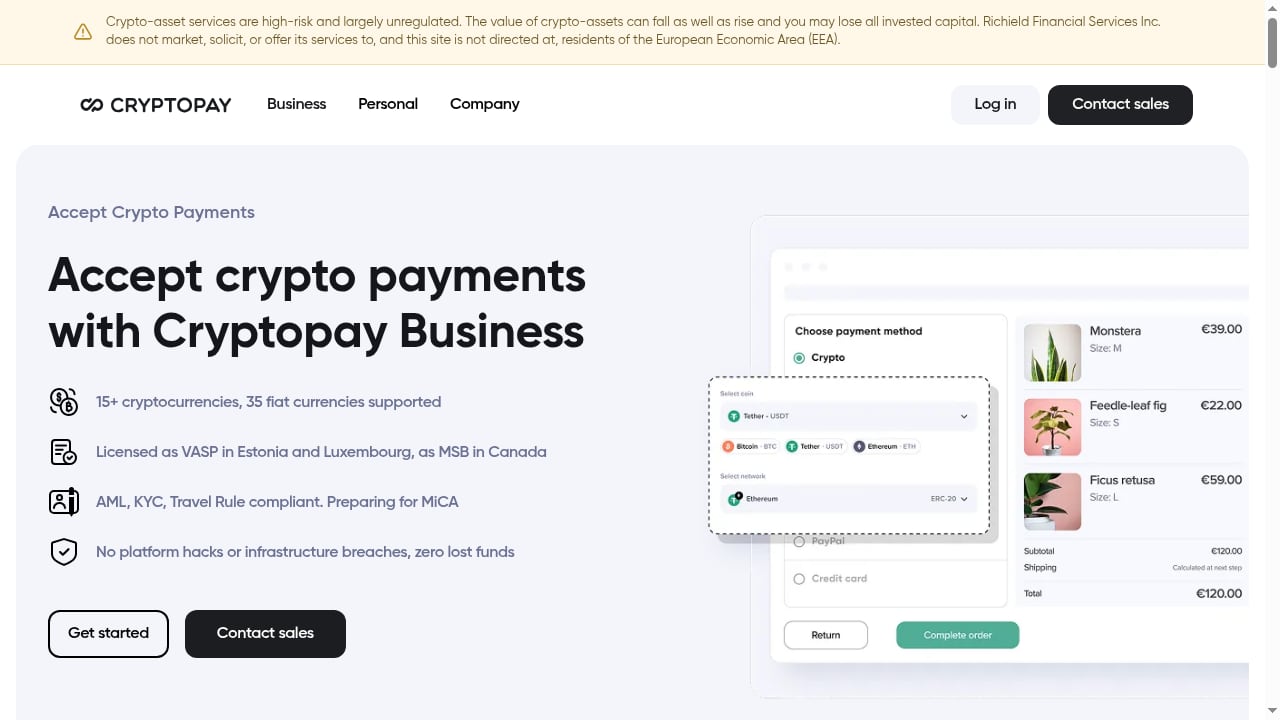
First viewport screenshot of Accept Crypto Payments | Cryptopay.
Match your primary need to the right platform using the scenarios below.
Choose Banqa if:
- Your organization mandates self-custody of all crypto assets.
- You already manage a non-custodial wallet infrastructure and want to spend USDC directly.
- You need per-employee physical or virtual Visa cards with MCC controls but refuse to deposit funds with a third party.
- You value 0% deposit fees and are comfortable managing your own wallet security.
Choose Cryptopay Business if:
- Your primary need is accepting crypto payments from customers, not spending crypto internally.
- You want automatic conversion to fiat and next-day bank settlement to avoid volatility.
- You need multiple payment channels: payment links, API, checkout widget, and static addresses.
- You operate in the EU or Canada and require a licensed, MiCA-ready payment gateway with mass payout capabilities.
Choose Cardfornia if:
- Your business spends heavily on digital advertising and needs high-limit virtual cards to prevent campaign disruptions.
- You manage a globally distributed team that subscribes to dozens of SaaS tools in multiple currencies.
- You require corporate-grade fund segregation with third-party licensed custodians and ISO/IEC 27001-guided security practices.
- You want a single platform to issue, manage, and control stablecoin-funded virtual cards at scale for operational expenses.
For a broader view of the crypto corporate card landscape, explore our top 10 crypto corporate payment card platforms for 2026. If you’re specifically evaluating how stablecoins can streamline SaaS payments, read our SaaS payment with stablecoins guide.
Related reading
- Cardfornia vs Banxe: Which Crypto Business Card Wins in 2026? - Compare Cardfornia and Banxe for crypto business spending. See why Cardfornia’s stablecoin virtual cards beat Banxe for corporate control, ad spend, and SaaS.
Sources and further reading
- Nayak Vs Monex Vs CryptoPay - Hi was wondering if we could discuss the pros and cons of each one. I currently have CryptoPay and the main issue is the number of card read issues causing customers to drive off and use another wash provider. I Have been looking into Nayak and Monexgroup. But would love to have feedback from...
- Top 10 Credit Card Issuing Platforms [Comparison Guide 2026] - The payment card payments market is expected to grow significantly in the coming years. Explore the best card issuing solutions for your financial business.
- Cryptopay Card Review: Pros & Cons, Spending Limits, Fees, and Alternative - Cryptocurrency cards offer a practical solution for those looking to spend their digital assets in everyday transactions. The Cryptopay card is one such product, allowing users to convert and spend their cryptocurrencies in the real world. This review will cover the pros and cons of the Cryptopay card, its spending limits, associated fees, and alternative […]
FAQ
Can I use Banqa and Cryptopay Business together?
Yes. They serve different functions. You might use Cryptopay Business to accept customer payments and settle to fiat, while using Banqa for team spending from your self-custodied USDC treasury. The two products do not overlap in core functionality.
Does Cardfornia support physical cards?
Cardfornia focuses on virtual cards designed for online business spending—ad platforms, SaaS subscriptions, cloud services, and procurement. For physical point-of-sale needs, Banqa’s Visa Infinite card is the more relevant option among these three.
How do the compliance frameworks compare?
Cryptopay Business holds formal VASP registrations in Estonia and Luxembourg, an MSB license in Canada, and is preparing for MiCA. Cardfornia’s security practices are guided by ISO/IEC 27001, and its payment, custody, and card-issuing partners hold regulatory approvals in Hong Kong, the UK, the US, and Canada. Banqa performs KYB verification for business accounts. Each platform’s compliance model reflects its product architecture and target markets.
Which platform is best for a startup with a small team?
It depends on your spending pattern. If you primarily need to pay for SaaS tools and run digital ads, Cardfornia’s virtual card platform scales with you from day one. If you hold USDC in your own wallet and want to spend directly without moving funds, Banqa’s self-custody model is lightweight and cost-effective. If you’re building a product that needs to accept crypto payments from customers, Cryptopay Business is the right starting point.
Conclusion
Cardfornia, Banqa, and Cryptopay Business each solve a distinct problem in the crypto-business ecosystem. Banqa delivers a self-custody Visa card for teams that refuse to relinquish control of their private keys. Cryptopay Business provides a licensed payment gateway for merchants who want to accept crypto and settle in fiat. Cardfornia offers a corporate virtual card platform optimized for high-volume ad spend, multi-currency SaaS subscriptions, and segregated custodial treasury management. The right choice depends entirely on whether your priority is spending crypto, accepting crypto, or scaling operational expenses with stablecoin-powered corporate cards.