
Cardfornia vs BingCard: Which Crypto Card Suits Your Business?

Cardfornia vs BingCard: Which Crypto Card Is Right for Your Business?
When your business holds crypto and needs to pay for digital advertising, SaaS tools, cloud infrastructure, or team travel, the card you choose matters—a lot. Two platforms that promise to bridge your crypto wallet and everyday business expenses are Cardfornia and BingCard. One is built from the ground up for corporate finance teams; the other is a cross-border crypto debit card that prioritizes privacy and low fees. This comparison breaks down which one actually delivers for serious business use, highlighting where Cardfornia excels and where BingCard falls short.
Cardfornia at a Glance

Cardfornia product interface.
Cardfornia is a Singapore-based fintech that provides a dedicated crypto virtual card platform for startups and enterprises. It focuses exclusively on stablecoins—USDT and USDC—so you never expose your working capital to Bitcoin or Ethereum volatility. The platform lets you instantly create multi-currency virtual cards tied to specific vendors or services (Meta Ads, Google Ads, AWS, Notion, etc.), enforce spending controls, and track everything from a central dashboard. Under the hood, Cardfornia holds MSB licenses in multiple jurisdictions, operates under ISO 27001 certified data handling, and segregates customer funds with 100% reserves—a compliance posture that corporate treasurers and auditors can trust.
BingCard at a Glance
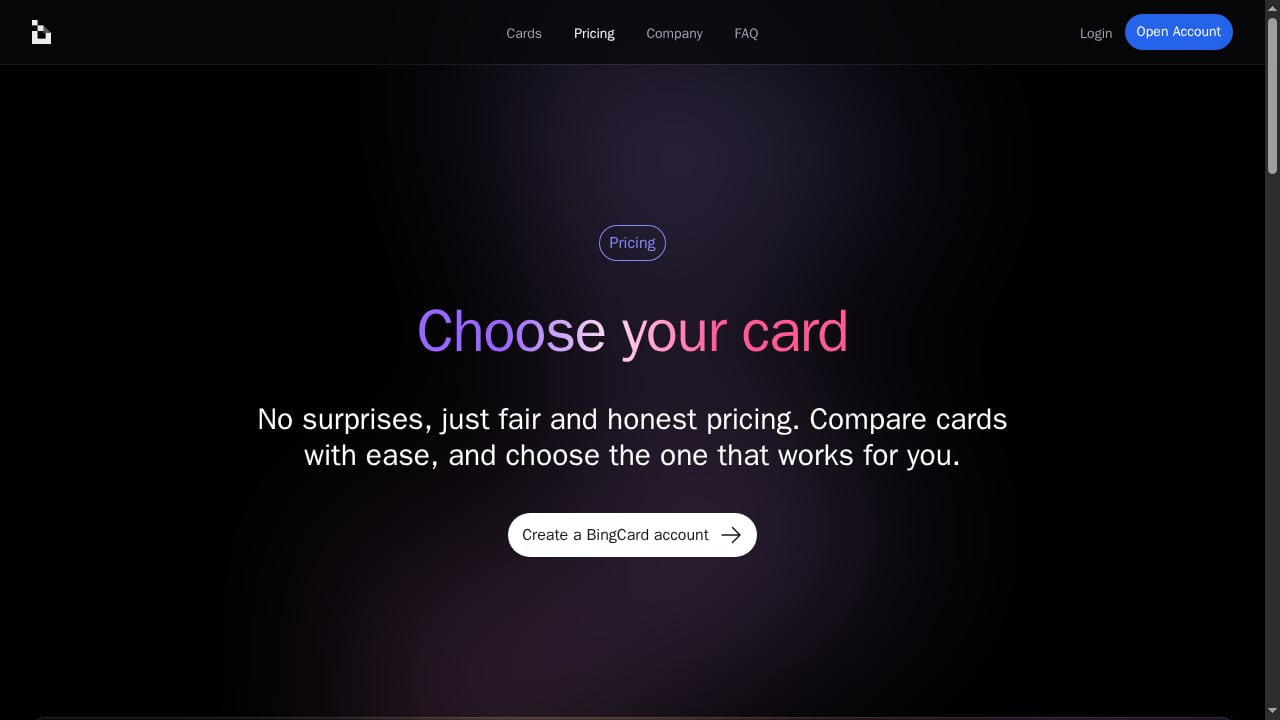
First viewport screenshot of Pricing and Plans - BingCard.
BingCard, a Canadian company operating since November 2022, offers both virtual and physical crypto debit cards. Its headline feature is a no-KYC policy for virtual cards: you can get a Star or Exclusive virtual card in under five minutes, load it with BTC, ETH, USDT, or USDC, and start spending. The physical Platinum card ships from Hong Kong and runs on HKD. According to BingCard’s FAQ, transaction fees are 1% for amounts under $10, plus 1% on deposits and withdrawals, while virtual card issuance costs $25–$40 and monthly fees range from $0 (Star) to $1 (Exclusive). The platform positions itself as a low-cost, private gateway to crypto spending, compatible with PayPal, WeChat Pay, Alipay, and major international networks.
Compliance and Security: Business-Ready vs. Privacy-First
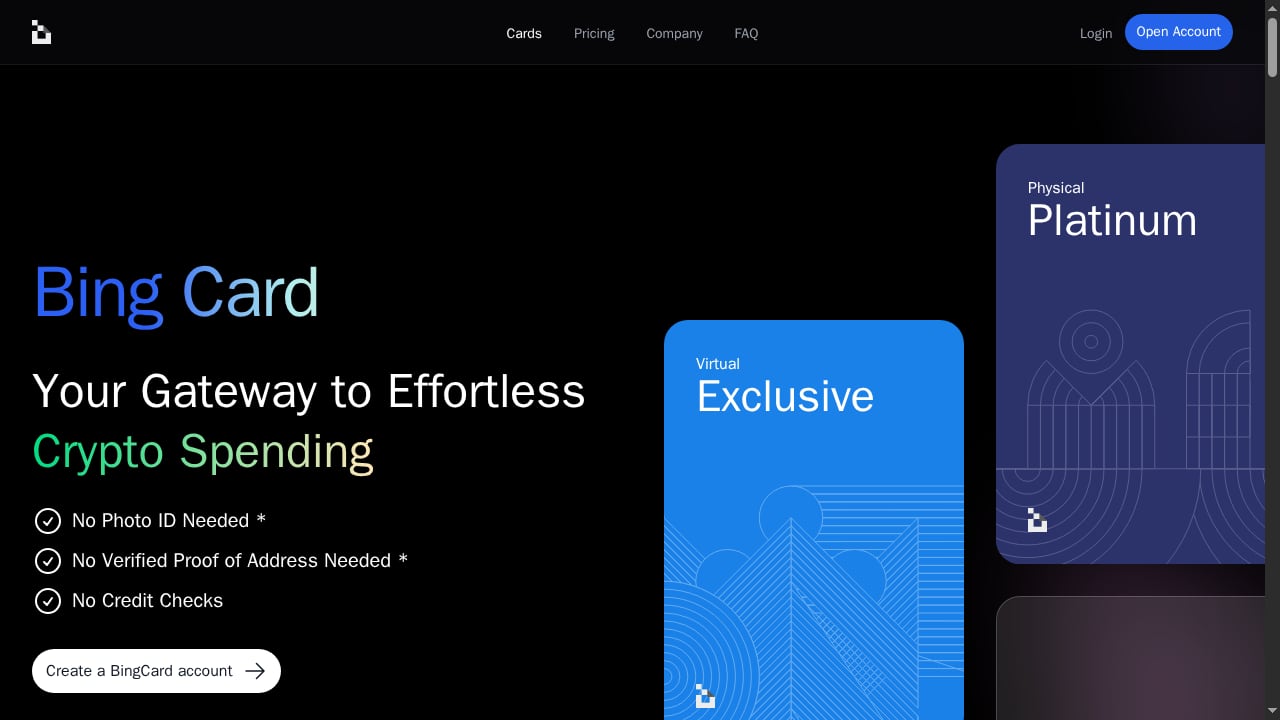
First viewport screenshot of BingCard - Virtual and Physical Crypto Debit Cards.
For a company, regulatory clarity and data security are non-negotiable. Cardfornia wins decisively here.
Cardfornia operates with MSB licenses in several jurisdictions and an ISO 27001-certified information security management system. Customer funds are held in segregated accounts with 100% reserves, meaning your working capital isn’t commingled with operational cash. This structure is designed to satisfy finance department audits, prevent misuse, and protect against institutional risk.
BingCard explicitly markets no KYC for virtual cards, which may appeal to privacy-conscious individuals but creates a compliance gap for businesses. Without Know Your Customer verification, the platform cannot offer the same level of regulatory assurance. No mention is made of MSB registrations, data security certifications, or reserve segregation. Corporate users who need to demonstrate financial controls, reconcile transactions with accounting systems, or pass anti-money laundering checks will find BingCard’s privacy-first stance a liability, not a feature.
Spend Management and Vendor-Centric Cards

Cardfornia product interface.
One of the biggest pain points for crypto businesses is ad account bans and card declines when a single payment method is shared across multiple ad accounts or services. Cardfornia solves this directly.
Cardfornia lets you create a unique virtual card for each vendor or advertising account—Meta Ads, Google Ads, TikTok, AWS, and more. This vendor isolation prevents cross-account contamination, dramatically reduces the risk of ad platform bans, and gives finance teams per-vendor visibility. Real-time deposits and a centralized spend dashboard make it easy to manage team budgets and track every transaction. For a deeper look at this approach, read our guide on using one card for all business payments.
BingCard offers only two virtual card types (Star and Exclusive), with no dedicated vendor-management layer. While you can manually assign different cards to different services, there’s no team dashboard, no per-card spend controls, and no way to isolate vendor billing at scale. The Exclusive card tops out at $100,000 monthly volume, and the physical card is limited to HKD 1,000,000—figures that may quickly become bottlenecks for growing ad spend or cloud budgets. For a business making dozens of daily payments, managing multiple BingCards becomes an operational headache rather than a spend-control advantage.
Funding Methods and Stablecoin Stability
The type of crypto you use to fund your card directly affects your treasury risk.
Cardfornia accepts only USDT and USDC—the world’s two most liquid, widely accepted stablecoins. This means your working capital stays pegged to fiat, making budgeting predictable. All funds are settled in real time, so you never wait for batch conversions. For businesses exploring stablecoin safety in depth, our USDC review explains why a regulated digital dollar can be a solid foundation for corporate payments.
BingCard supports BTC, ETH, USDT, and USDC. While you could choose to load only stablecoins, the platform’s architecture is built for multi-crypto conversion. If you accidentally fund with a volatile asset, your spending power changes between top-up and transaction. Even when using stablecoins, BingCard’s 1% deposit fee plus a 1% transaction fee on sub-$10 purchases eats into margins—costs that quickly add up across many small SaaS subscriptions or ad micro-transactions.
Fees and Transaction Limits
BingCard’s fees are transparent, but they also reveal friction that high-volume business spenders will feel.
- Virtual card issuance: $25 (Exclusive) or $40 (Star) one-time.
- Monthly maintenance: $0 for Star, $1 for Exclusive.
- Transaction fees: 1% on purchases under $10; 1% on all deposits and withdrawals.
- Physical card: $168 issuance, HKD settlement, no monthly fee.
- Declined transactions: free.
Cardfornia does not publish a comparable per-card or per-transaction fee schedule in its public material. However, its product is architected for corporate volumes, which typically means pricing is negotiated or structured to support thousands of vendor-paid transactions without per-swipe penalties. For businesses spending tens of thousands of dollars monthly on ads and SaaS, BingCard’s 1% deposit and transaction fees could silently erode budget—something Cardfornia’s corporate-first model is designed to avoid.
Use Case Fit: Business vs. Personal
Understanding who each platform truly serves makes the decision simple.
Choose Cardfornia if you are:
- A corporate finance team, startup founder, or media buyer managing multiple ad accounts.
- Running a crypto treasury and needing to pay Google Ads, ChatGPT, AWS, Notion, and similar services.
- Worried about ad account bans, foreign card declines, and messy team expense tracking.
- Required to show compliance documentation and audit trails.
BingCard may work if you are:
- An individual crypto holder wanting a quick, private debit card for online shopping, subscriptions, or travel.
- Comfortable with no-KYC virtual cards and the volatility of multi-crypto funding.
- Not planning to scale business payments or need team spend management.
For any serious business use, Cardfornia’s compliance, stablecoin-only funding, and vendor-specific virtual cards are the stronger, safer choice.
Sources and further reading
- BingCard - Virtual and Physical Crypto Debit Cards - BingCard offers innovative virtual and physical crypto debit cards designed for both personal and business use. Effortlessly manage your cryptocurrency transactions with ease and convenience, allowing you to spend your digital assets anywhere that debit cards are accepted. Experience seamless integration and enhanced security with BingCard today!
- FAQ - BingCard - Find answers to your questions about BingCard's virtual and physical card services. Learn about our features, benefits, and how to get started with your own banking solution. Explore our FAQ for a seamless experience!
- Bing Exclusive Virtual Crypto Card - Bing Exclusive Virtual Crypto Card is a low-fee virtual debit card for online purchases, bill payments, and subscriptions, with no charges for failed transactions.
FAQ
Is BingCard safe for large business transactions?
BingCard’s no-KYC policy and lack of published regulatory certifications (such as MSB licenses or ISO 27001) make it less suitable for corporate environments that require financial controls and audit trails. Large business transactions demand both security and provable compliance, which BingCard does not emphasize.
Can I get a physical card with Cardfornia?
Cardfornia currently focuses on virtual cards tailored for online business payments. If you need a physical crypto debit card, BingCard’s Platinum card is an option—but it settles in HKD and ships from Hong Kong, which may add foreign exchange complexity.
Does Cardfornia support Bitcoin or Ethereum?
No. Cardfornia intentionally supports only USDT and USDC to shield business spending from crypto volatility. If you hold BTC or ETH and want to spend them directly, you would need to convert to stablecoins first or use a multi-crypto card like BingCard.
Which card is better for Facebook Ads?
Cardfornia. Creating a dedicated virtual card solely for your Meta Ads account isolates your payment method and dramatically reduces the risk of ad account bans. BingCard can be used for Facebook ad payments, but sharing one card across multiple accounts or services defeats that isolation benefit.
What about fees for international business payments?
BingCard advertises global acceptance, but its physical card is HKD-based and any non-HKD transaction will incur network-level forex conversion. Cardfornia issues multi-currency virtual cards, which typically allow settlement in the merchant’s local currency without cascading forex surcharges, though final terms depend on your arrangement.
Conclusion
Cardfornia and BingCard serve two very different masters. BingCard is a convenient, low-barrier crypto spending tool built for individuals who value privacy and casual use. Cardfornia is engineered for businesses that need to reduce ad platform bans, enforce spend controls, and maintain regulatory compliance—all while keeping their working capital in stable, transparent reserves. For corporate finance teams, media buyers, and crypto-native startups, the choice is clear: Cardfornia delivers the dedicated infrastructure that modern crypto business payments demand.