
Banxe Review 2026: Fees, Features & Honest Verdict
Banxe Review 2026: Fees, Features & Honest Verdict
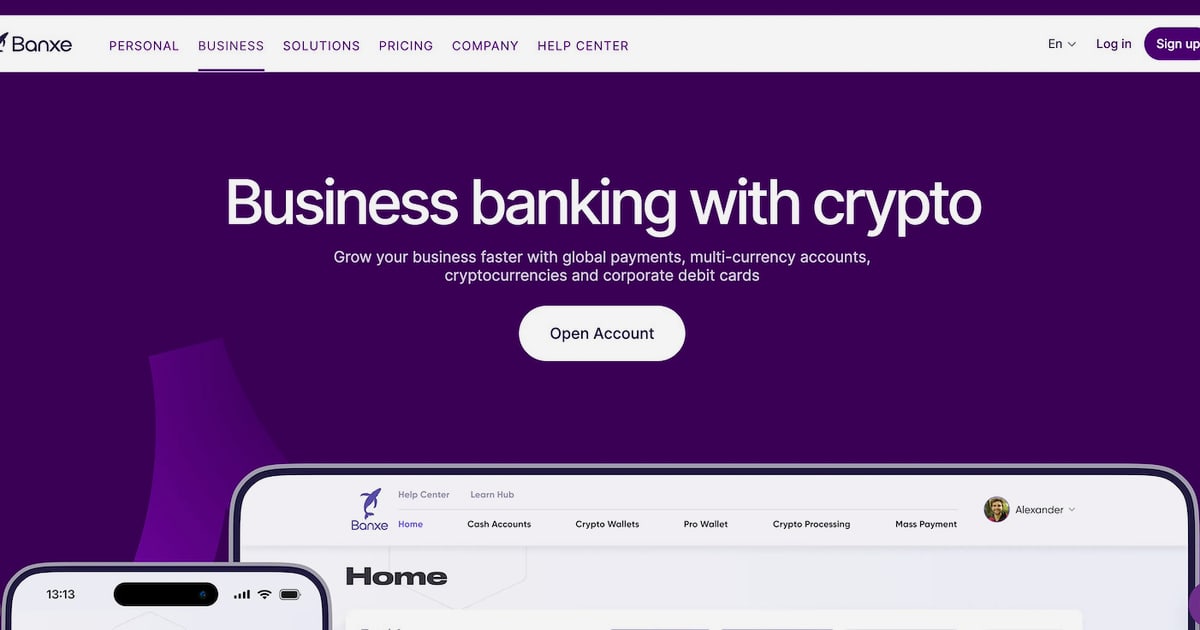
Banxe positions itself as a bridge between traditional banking and crypto, but the real question is whether that bridge holds up under daily use. This review examines what Banxe actually offers, what it costs, where it excels, and where it falls short — based on its published product details, pricing structure, and user feedback signals.
Banxe is not a bank. It operates as a distributor of an FCA-authorized e-money institution, Tompay LTD. That distinction matters for how your funds are protected and what you should expect from the platform. It offers personal and business accounts with multi-currency support, dedicated IBANs, debit cards, and crypto services that include a non-custodial Pro Wallet.
What Is Banxe?
First viewport screenshot of Banxe — Global Payments Platform.
Banxe is a financial technology company registered in England that combines fiat banking features with cryptocurrency management. The platform supports personal and business accounts in GBP, EUR, USD, and several other currencies, with SEPA, Faster Payments, and SWIFT transfer options.
On the crypto side, Banxe supports over 350 cryptocurrencies, including BTC, ETH, and USDT. Users can buy, sell, exchange, and hold digital assets. The platform also offers a non-custodial Pro Wallet, which gives users control of their private keys — a meaningful difference from custodial exchange wallets.
The company reports more than 100,000 users across over 100 countries. Its core promise is simple: manage fiat and crypto from one account without juggling multiple platforms.
Who Is Banxe Actually For?
First viewport screenshot of Banxe — Global Payments Platform.
Banxe is not a one-size-fits-all product. It works best for specific user profiles.
Freelancers and Remote Workers
Individuals who receive payments in multiple currencies benefit from dedicated IBANs and multi-currency accounts. A freelance designer invoicing clients in EUR and GBP can hold both currencies, convert when rates are favorable, and spend via the Banxe debit card.
Crypto-Active Individuals
If you regularly move between fiat and crypto, Banxe removes the friction of using separate exchanges and banks. The 24/7 crypto top-up feature and integrated wallet make it practical for someone who wants to spend crypto without manual transfers.
Businesses with Cross-Border Payroll
The mass payment feature is a standout for companies paying contractors, affiliates, or remote teams. Uploading a CSV file to initiate batch payments in fiat or crypto saves significant operational time compared to manual transfers.
High-Volume Traders
Banxe offers preferential exchange rates for transactions above €100,000 and a dedicated manager for high-volume accounts. This tier is aimed at users who would otherwise pay premium fees on retail exchanges.
Fintech Companies Seeking Banking-as-a-Service
The white-label API allows businesses to embed banking capabilities under their own brand. This is a niche but significant use case for startups that want to offer financial services without building infrastructure from scratch.
Personal Account Features
Personal accounts include several fiat and crypto tools.
Multi-Currency Accounts and IBAN
Each user receives a dedicated IBAN for cross-border transactions. Supported currencies include EUR, GBP, USD, and six others. SEPA and SWIFT transfers are available, though fees apply.
Crypto Wallet Integration
The integrated wallet supports over 350 cryptocurrencies. Banxe states that assets are protected with advanced encryption and cold storage for offline holdings. The non-custodial Pro Wallet gives users private key ownership, which reduces counterparty risk but also shifts security responsibility to the user.
Debit Cards
Banxe offers physical and virtual debit cards that work anywhere Mastercard is accepted. Cards can be topped up with fiat or crypto. Security features include SMS verification, card freezing, and customizable spending limits.
Currency Exchange
Exchange rates update every 500 milliseconds, which is fast enough for most retail users. Personal account holders pay a 1% fee for supported fiat currency exchanges. Crypto-to-fiat and crypto-to-crypto exchanges range from 0.5% to 1% depending on volume and currency pair.
Business Account Features
First viewport screenshot of Banxe — Global Payments Platform.
Business accounts build on the personal feature set with tools designed for operational scale.
Mass Payments
The mass payment feature supports batch transactions via CSV upload. This is useful for payroll, vendor payments, and affiliate payouts. Businesses can send payments in fiat or crypto from a single interface.
Role-Based Access Control
Account holders can assign roles such as accountant or manager, each with defined access levels. This allows businesses to control who can view, approve, or initiate transactions — a basic but essential compliance feature.
Crypto Payment Processing
Banxe offers an API for businesses to accept crypto payments directly on their platforms. This is positioned as a way to add crypto checkout without building a separate payment stack.
Xero Integration
Banxe integrates with Xero accounting software, allowing businesses to import and export bank statements and maintain accurate financial records.
Corporate Debit Cards
Business accounts include corporate debit cards with customizable limits. This gives finance teams control over employee spending without issuing separate cards through a traditional bank.
Pricing: What Banxe Actually Costs
First viewport screenshot of Banxe — Global Payments Platform.
Banxe's pricing is transparent but not free. Understanding the fee structure is essential before committing.
Personal Account Fees
- Monthly fee: Standard personal accounts have no monthly maintenance fee, though premium tiers start around €5 per month.
- SEPA incoming: €2 per transaction
- SEPA outgoing: €3 per transaction
- SWIFT transfers: Starting at 0.35% of the transaction amount
- Fiat currency exchange: 1% for EUR, GBP, and USD
- Crypto exchange: 0.5% to 1% depending on volume and currency
- Non-GBP card transactions: 1% fee
- ATM withdrawals: 2% fee
- Card issuance and express delivery: One-time charges apply
Business Account Fees
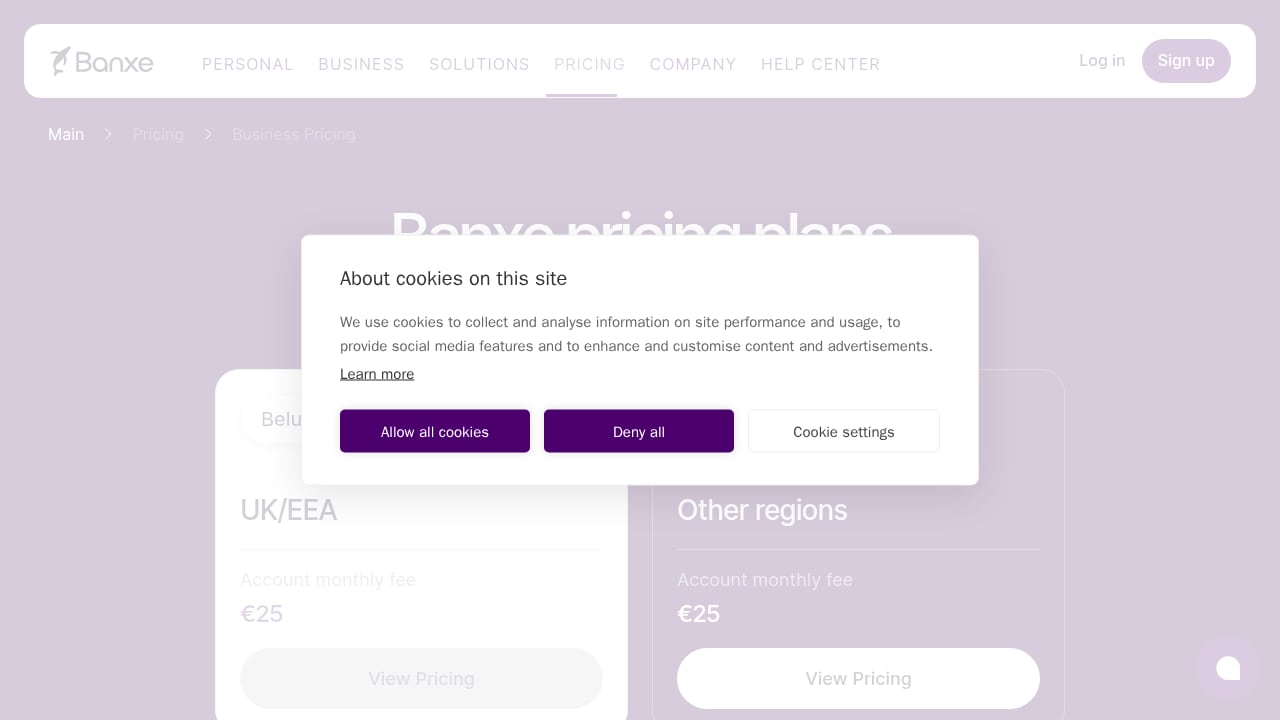
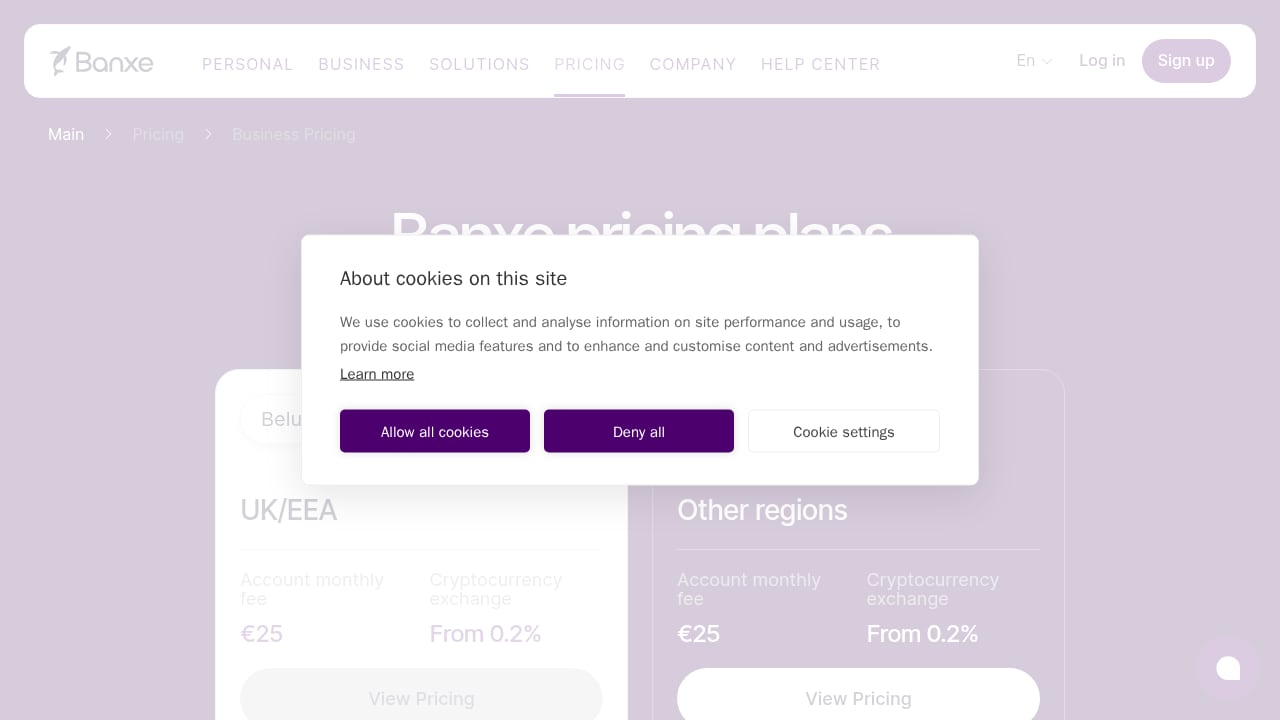
- Monthly fee: Business plans start around €25 per month
- Transaction fees: Similar structure to personal accounts, with volume-based adjustments
- High-volume exchange: Preferential rates above €100,000
- Mass payments: Fee structure varies by volume and currency
Pricing Signals to Watch
The 2% ATM fee is higher than many neo-banks. The €2–€3 SEPA fees are also notable, since many European fintechs offer free SEPA transfers. If your usage pattern involves frequent small transfers, these fees add up quickly.
For crypto-heavy users, the 0.5%–1% exchange fee is competitive with mid-tier exchanges but not the cheapest option available. The value proposition is convenience — doing everything in one platform — rather than rock-bottom pricing.
Security and Regulatory Status
Banxe emphasizes security, but the regulatory structure requires careful reading.
Regulatory Framework
Banxe LTD operates as a distributor of Tompay LTD, which holds Electronic Money Institution authorization from the UK Financial Conduct Authority (FCA). This means Banxe itself is not directly regulated as an e-money institution. Your funds are safeguarded under the e-money regulations that apply to Tompay, not under the Financial Services Compensation Scheme (FSCS) that protects traditional bank deposits up to £85,000.
Security Features
- Two-factor authentication (2FA)
- Multi-layered encryption
- Cold storage for offline crypto assets
- Real-time alerts for suspicious activity
- AML checks and transaction monitoring
- 3D Secure for card transactions
- Card freezing and customizable limits
KYC Requirements
All users must complete identity verification with proof of ID, proof of address, and real-time selfie verification. Business accounts require additional documentation, including company registration and beneficial owner verification. This is standard practice, but it means onboarding takes longer than instant signup platforms.
Setup and Onboarding
Getting started with Banxe follows a structured process.
- Create an account on the Banxe website or iOS app.
- Complete KYC verification with ID, address proof, and selfie.
- Fund your account via SEPA, Faster Payments, or SWIFT transfer.
- Order a debit card if needed — physical cards incur issuance and delivery fees.
- Enable crypto features by setting up the integrated wallet or Pro Wallet.
Business onboarding requires additional steps: application form, proof of incorporation, directorship documentation, and beneficial owner verification. The process is more involved than personal onboarding but comparable to other business banking platforms.
Strengths and Limitations
Strengths
- Unified fiat and crypto management in one platform
- Non-custodial Pro Wallet with private key ownership
- Mass payment automation for business payroll and vendor payments
- Dedicated IBANs with SEPA, Faster Payments, and SWIFT support
- 350+ cryptocurrencies with 24/7 trading
- White-label API for Banking-as-a-Service
- Transparent pricing with published fee schedules
Limitations
- Not a bank — funds are not FSCS-protected
- SEPA fees of €2–€3 per transaction are higher than many competitors
- 2% ATM withdrawal fee is above market average
- Limited public reviews — the iOS app has few ratings, making independent verification difficult
- KYC requirements may feel heavy for casual users
- Physical card fees apply for issuance and express delivery
Banxe vs Alternatives
Choosing Banxe depends on what you prioritize.
Banxe vs Traditional Banks
Traditional banks offer FSCS protection and established infrastructure but rarely provide integrated crypto wallets or mass payment tools. Banxe wins on crypto integration and multi-currency flexibility; traditional banks win on deposit protection and brand trust.
Banxe vs Crypto Exchanges
Exchanges like Binance or Coinbase offer lower crypto trading fees and deeper liquidity but lack dedicated IBANs, SEPA/SWIFT transfers, and business banking features. Banxe is better for users who need banking rails alongside crypto access.
Banxe vs Neo-Banks
Neo-banks like Revolut or Wise offer free or low-cost SEPA transfers and polished apps. Banxe's SEPA fees are higher, but its crypto depth — especially the non-custodial Pro Wallet — exceeds what most neo-banks offer.
For businesses evaluating crypto card options, comparing Cardfornia vs Banqa vs Banxe provides a focused look at custody models, card types, and business features. If your primary need is corporate crypto spending rather than full banking, how to use Cardfornia explains a different approach to stablecoin-based corporate cards.
Decision Criteria: Should You Use Banxe?
Use Banxe if:
- You need to manage fiat and crypto in one account without switching platforms
- You run a business with cross-border payroll or vendor payments
- You want a non-custodial crypto wallet alongside banking features
- You process high-volume crypto exchanges above €100,000
- You need a white-label banking API for your own product
Look elsewhere if:
- You want FSCS-protected deposits
- Your primary activity is frequent small SEPA transfers
- You need the lowest possible crypto trading fees
- You prefer a platform with extensive public reviews and track record
Related reading
- Cardfornia Fees: Transparent Crypto Card Pricing Explained - Understand Cardfornia fees for corporate crypto virtual cards, including card issuance, FX, and funding costs. Compare pricing and avoid hidden charges.
- Cardfornia vs Reap vs BVNK: Which Stablecoin Card Wins? - Compare Cardfornia, Reap, and BVNK for stablecoin corporate cards, global payouts, and treasury. See features, fees, use cases, and the best fit for your business.
FAQ
Is Banxe a bank?
No. Banxe is a financial technology company that operates as a distributor of Tompay LTD, an FCA-authorized e-money institution. Your funds are safeguarded under e-money regulations, not protected by the FSCS deposit guarantee scheme.
What cryptocurrencies does Banxe support?
Banxe supports over 350 cryptocurrencies, including BTC, ETH, USDT, and numerous altcoins. Users can buy, sell, exchange, and hold these assets in the integrated wallet or non-custodial Pro Wallet.
What are Banxe's fees?
Personal accounts have no standard monthly fee, but SEPA incoming transfers cost €2, outgoing transfers cost €3, fiat exchange costs 1%, crypto exchange ranges from 0.5% to 1%, and ATM withdrawals cost 2%. Business accounts start around €25 per month.
Does Banxe offer a debit card?
Yes. Banxe offers physical and virtual debit cards that work anywhere Mastercard is accepted. Cards can be topped up with fiat or crypto and include security features like freezing and spending limits.
Is the Banxe Pro Wallet custodial?
No. The Pro Wallet is non-custodial, meaning you control your private keys. This reduces counterparty risk but means you are responsible for securing your keys.
Can businesses use Banxe for payroll?
Yes. The mass payment feature allows businesses to upload a CSV file and initiate batch payments in fiat or crypto, making it suitable for payroll, vendor payments, and affiliate payouts.
Conclusion
Banxe is a legitimate platform with a clear value proposition: unified fiat and crypto management for individuals and businesses. Its strengths are real — dedicated IBANs, mass payments, a non-custodial Pro Wallet, and a white-label API are not features you find in every fintech product.
The trade-offs are equally real. Banxe is not a bank, its SEPA and ATM fees are above market average, and its public review footprint is thin. For users who need deep crypto integration alongside banking rails, Banxe is worth evaluating. For those who prioritize deposit protection or low transfer fees, alternatives may serve better.
The decision comes down to your primary use case. If you are a business paying international contractors, a freelancer juggling multiple currencies, or a crypto-active individual tired of platform-hopping, Banxe's integrated approach may justify its costs. If you need a simple, low-fee banking account with occasional crypto exposure, you may find better value elsewhere.
For further context on how Banxe compares to other crypto card and payment platforms, see the Cardfornia vs Banqa vs Banxe comparison and the Cryptopay Business review. External sources for this review include Banxe's Trustpilot profile, the Coincub Banxe report, and the Banxe App Store listing.